




The Five Pillars of Islam: A Clear Guide to Each Pillar
The five pillars of Islam are five core acts of worship: Shahada, Salah, Zakat, Sawm, and Hajj. Together, they turn faith into daily action, from prayer and charity to fasting and pilgrimage. This guide explains each pillar with authentic Qur’an and Hadith sources.
Reviewed for accuracy against authentic sources.
Every Muslim, from a student in Malaysia to a farmer in Morocco, builds life on the five pillars of Islam. Yet many readers ask where these acts come from and why they matter. So, what exactly are they?
In this guide, you will learn the meaning, evidence, and purpose of each of the five pillars of Islam. You will also see how the pillars shape daily life, and how scholars answer common questions.
The Five Pillars at a Glance
Scan this table first. Then read the details of each pillar below.
| Pillar | Meaning | How Often |
|---|---|---|
| 1. Shahada | Declaration of faith | Once to enter Islam, then repeated in prayer |
| 2. Salah | The five daily prayers | Five times every day |
| 3. Zakat | Obligatory charity | Once every lunar year |
| 4. Sawm | Fasting in Ramadan | One month every year |
| 5. Hajj | Pilgrimage to Makkah | Once in a lifetime, if able |
What Are the Five Pillars of Islam?
The Prophet (PBUH) described Islam as a building with five supports. Islam rests on five supports: faith, prayer, Zakat, fasting, and Hajj (Sahih al-Bukhari: 8; Sahih Muslim: 16).
The same list appears in the famous Hadith of Jibril (Gabriel). In human form, the angel asked the Prophet (PBUH) to define Islam. His answer named the five pillars of Islam in order (Sahih Muslim: 8).
Each pillar builds on the one before it. Belief comes first, because action without belief carries no weight. Then prayer, charity, fasting, and pilgrimage follow as the practical expression of that belief.
1. Shahada: The Declaration of Faith
Shahada is the testimony that there is no god but Allah, and that Muhammad is His messenger. It is the entry point into Islam and the foundation of every other pillar.
أَشْهَدُ أَنْ لَا إِلَهَ إِلَّا اللَّهُ، وَأَشْهَدُ أَنَّ مُحَمَّدًا رَسُولُ اللَّهِ
Ash-hadu an la ilaha illallah, wa ash-hadu anna Muhammadan rasulullah.
“I bear witness that there is no god but Allah, and that Muhammad is the Messenger of Allah.”
A person says these words to enter Islam. Muslims also repeat them in every prayer, during the call to prayer (Adhan), and ideally as their final words.
The Qur’an describes this belief directly. “Allah bears witness that there is no deity except Him” (Qur’an 3:18). Therefore, Shahada is both a statement of the tongue and a commitment of the heart.
2. Salah: The Five Daily Prayers
Salah means the five obligatory prayers. Muslims perform them at dawn, midday, afternoon, sunset, and night. Each prayer follows a fixed structure of standing, bowing, and prostration while facing the Kaaba in Makkah.
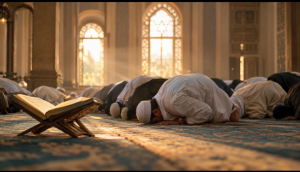
The Qur’an instructs believers to “establish prayer at the decline of the sun until the darkness of the night” (Qur’an 17:78). Scholars connect this verse to the timing of the daily prayers. As a result, Salah keeps a Muslim in regular contact with Allah (SWT) throughout the day.
| Prayer | Time | Obligatory Rak’ahs |
|---|---|---|
| Fajr | Dawn | 2 |
| Dhuhr | After midday | 4 |
| Asr | Afternoon | 4 |
| Maghrib | Just after sunset | 3 |
| Isha | Night | 4 |
Why Prayer Times Matter
Each prayer has a defined time window. Scholars warn against delaying a prayer without a valid excuse. However, anyone who forgets a prayer should pray it when he remembers (Sahih al-Bukhari: 597).
This flexibility shows the balance of the five pillars of Islam. They combine firm structure with real human limits.
3. Zakat: Obligatory Charity
Zakat is a mandatory yearly payment from a Muslim’s savings. A Muslim pays it to people in need, once his wealth passes a set threshold called nisab. The usual rate on cash savings is 2.5 percent.
Unlike voluntary charity, Zakat is a fixed religious duty. You can learn the steps in our guide on how to calculate and pay Zakat.
The Qur’an names eight categories of recipients, such as the poor, the needy, and those in debt (Qur’an 9:60). Thus, Zakat has a clear purpose beyond simple kindness.
Zakat also purifies the giver’s wealth and heart. It reminds the rich that every blessing belongs to Allah (SWT).
4. Sawm: Fasting During Ramadan
Sawm is the duty to fast from dawn until sunset in the month of Ramadan. Muslims avoid food, drink, and other physical needs during these hours. In this way, they practice discipline and devotion.
The Qur’an states this duty clearly. “Fasting is decreed upon you as it was decreed upon those before you, that you may become righteous” (Qur’an 2:183). So, fasting links us to earlier faiths, and its goal is God-consciousness (Taqwa).
Who Is Exempt From Fasting
Islam exempts the sick, the elderly, pregnant or nursing women, and travelers. Many make up the missed days later in the year. Others feed a person in need instead, depending on their case.
Scholars differ on some details, such as the exact rule for nursing mothers. Therefore, ask a trusted scholar about your own situation.
5. Hajj: Pilgrimage to Makkah
Hajj is the pilgrimage that every physically and financially able Muslim must perform at least once. Millions of pilgrims travel to Saudi Arabia each year in the Islamic month of Dhul Hijjah. Our first-time Hajj guide explains each day.
The Qur’an sets this duty directly. Pilgrimage to the House is due to Allah from whoever is able to find a way (Qur’an 3:97). That verse adds that Allah is independent of all creation. So, Hajj is a spiritual duty for us, not a burden placed on God.
Pilgrims perform several linked rites. They circle the Kaaba seven times, walk between Safa and Marwa, and stand in prayer at Mount Arafat. These acts recall the story of Prophet Ibrahim (AS) and his family.
Why These Pillars Still Matter Today
The five pillars of Islam give shared structure to more than a billion Muslims across many countries, languages, and cultures. A Muslim in Morocco and one in Malaysia recite the same declaration of faith. They both pray the same five prayers, and both fast in the same month.
Beyond obligation, each pillar builds a trait of character. Prayer builds discipline, and Zakat builds compassion. Fasting builds self-control, while Hajj builds humility.
This shared structure also creates practical unity. Travelers can find a mosque in almost any country, and they recognize the same prayer movements.
Likewise, charity networks built on Zakat cross borders easily. As a result, the five pillars of Islam work as a global anchor, not a set of regional customs. Indeed, the five pillars of Islam unite believers from every background.
How the Pillars Connect to Everyday Life
Many people think religious duties stay separate from daily routine. In practice, the five pillars of Islam are woven into how Muslims plan their mornings, budgets, and calendars.
- Salah: It divides the day into five checkpoints, so busy workers still pause for reflection.
- Zakat: It turns personal finance into worship, because calculating it means reviewing savings and debts each year.
- Sawm: It reshapes meals, sleep, and social plans for a whole month.
- Hajj: It often needs years of saving and planning before the trip.
Lessons From Each Pillar for Modern Life
Modern life is fast, noisy, and often lonely. In that setting, the five pillars of Islam offer steady anchors. Each one speaks to a real need that people feel today.
Shahada gives clarity. A person who knows what he believes can make decisions with confidence. As a result, he is less shaken by trends and pressure.
Salah gives rhythm. Five short pauses interrupt stress before it builds. Also, standing before Allah (SWT) reminds us that work is not the center of life.
Zakat gives balance. It teaches that wealth is a trust, not a possession. Therefore, it protects the heart from greed and the community from neglect.
Sawm gives control. A month of fasting trains us to say no to cravings. Later, that skill helps with anger, screens, and unhealthy habits.
Hajj gives unity. Standing together in simple white clothes erases every difference of rank. In the same way, it shows that all believers are equal before Allah (SWT).
A Beginner’s Plan to Practice the Pillars
If you are new to Islam, or you want to restart, build the pillars step by step. A slow start is better than a rushed one that fades.
- Week 1: Learn the meaning of the Shahada, and say it with understanding.
- Weeks 2 to 4: Learn Wudu and the prayer, and add one prayer at a time.
- Before Ramadan: Practice a few voluntary fasts, so the month feels easier.
- Each year: Review your savings, and pay Zakat if you pass the nisab.
- Long term: Save slowly for Hajj, and learn its rites in advance.
Also find a local mosque or a trusted online teacher. Learning with others keeps you consistent and answers your questions early.
Common Misconceptions About the Pillars
- Myth: The pillars are only rituals. In reality, each one trains character, from patience to generosity.
- Myth: Zakat is the same as any donation. However, Zakat is a fixed duty with set recipients, while voluntary charity (Sadaqah) is open.
- Myth: Hajj is required every year. Instead, it is required once for those who are able.
- Myth: Missing a pillar removes a person from Islam. Scholars treat missed acts as sins that call for repentance and make-up, not as disbelief, in most cases.
Frequently Asked Questions (FAQ)
Do All Five Pillars Carry Equal Importance?
Answer: Shahada is foundational, because belief must exist first. The other four flow from that declaration. Each of them remains a duty on its own.
What Happens If a Muslim Misses a Prayer or a Fast?
Answer: Scholars treat missed duties as matters of repentance and make-up, where this applies. Genuine hardship, illness, or inability meets with flexibility, not punishment.
Do Children Have to Follow the Five Pillars?
Answer: Young children are not held to adult obligations. The Prophet (PBUH) advised parents to teach prayer at age seven (Sunan Abi Dawud: 495). Therefore, many families introduce prayer, fasting, and charity step by step.
Which Pillar Should a New Muslim Learn First?
Answer: Start with Shahada and learn its meaning. Then learn how to pray, since Salah is the most frequent pillar.
Are There Other Duties in Islam Beyond the Five Pillars?
Answer: Yes. Honesty, kindness to parents, and good character are all part of Islam. The pillars are the base, and the rest of the faith rises on them.
Is Zakat Due on Gold and Savings?
Answer: Yes, when the total passes the nisab for a full lunar year. Scholars explain the exact figures, so check current values each year.
Final Thoughts
The five pillars of Islam offer more than a list of duties. They form a connected path from personal belief to community responsibility. Understanding them gives clear insight into the daily lives of over a billion Muslims.
Start with the pillar that feels hardest, and ask Allah (SWT) for help. Then keep the five pillars of Islam at the center of your week. Share this guide with someone who wants to learn about Islam. And Allah knows best.
References
- The Holy Qur’an: 2:183, 2:185, 3:18, 3:97, 9:60, and 17:78
- Sahih al-Bukhari: 8 and 597
- Sahih Muslim: 8 and 16
- Sunan Abi Dawud: 495
Author Bio
Explore Islamic World Editorial Team
The Explore Islamic World editorial team writes each guide from the Qur’an, Sahih al-Bukhari, Sahih Muslim, and the Sunan collections. We check every Hadith number against Sunnah.com before publishing. Where scholars differ, we present each view fairly.

Comments are closed.
-
-
-
-
-
-
-
-
-
-
Show Comments[…] this journey, Muslims believe the five daily prayers were established as an obligation. For this reason, the Night Journey holds deep spiritual […]
[…] of that wealth to one of the eight categories of recipients named in the Quran. Zakat is one of the Five Pillars of Islam. Every eligible Muslim must understand this process to fulfill the obligation correctly. This guide […]
[…] Salah. Since forgetfulness is a natural part of being human, Islam offers a compassionate solution instead of demanding a repeated prayer. Learning these rules removes doubt and restores confidence in your daily worship. […]
[…] parts called juz. This division lets Muslims read the entire text over one month, especially during Ramadan. Nearly every surah opens with the phrase “Bismillah ir-Rahman ir-Rahim,” meaning […]
[…] encouraged avoiding unnecessary late-night activity and maintained a life centered around the five daily prayers, including waking for Fajr. For many people, maintaining a consistent sleep schedule and getting […]
[…] purity is a prerequisite for key Islamic rites. Without valid Wudu, the five daily prayers are not considered valid. A clear grasp of the causes of Wudu invalidation protects worship from […]
[…] the five daily prayers on time builds a strong connection with Allah. Prayer reminds believers of their true […]
[…] symbolizes the straight path (Sirat al-Mustaqim). It reflects the dreamer’s devotion to the daily prayers, the Sunnah, and religious […]
[…] signals acceptance and relief from distress. Interpreters also link it with steadiness in the five daily prayers. Therefore, take it as a gentle push to protect your […]
[…] Increase your five daily prayers and Quran reading […]