





Tibb-e-Nabawi Healthy Life: 7 Sunnah Rules for Lasting Wellness
A Tibb-e-Nabawi healthy life follows seven simple Sunnah habits. These cover eating, drinking, food choices, sleep, cleanliness, anger, and gratitude. Each habit comes from the authentic teachings of Prophet Muhammad (PBUH). Together they remain just as relevant today as they were fourteen centuries ago.
Modern life often pulls people toward late nights, processed food, and constant stress. Many chronic health complaints trace back to habits the Prophet (PBUH) warned against long ago. Understanding these seven rules gives you a practical, faith-rooted framework for daily wellness.
What makes Tibb-e-Nabawi distinct is its focus on body and soul together. Moderate eating, for example, is both a physical safeguard and a spiritual discipline. The Qur’an discourages excess in food just as strongly as hadith does. This dual grounding is part of why the guidance has lasted so long. It also explains why scholars still teach these seven habits as a complete system, not isolated tips. Each rule reinforces the others, rather than working alone.
1. Tibb-e-Nabawi Rule One: Leave One-Third of Your Stomach Empty
Overeating is a common cause of fatigue, weight gain, and digestive trouble. Many people eat past the point of comfort without noticing. The Prophet (PBUH) addressed this directly in one of the most cited hadiths on food moderation.
Al-Miqdam ibn Ma’dikarib reported that the Messenger of Allah (PBUH) said human beings fill no vessel worse than the stomach. A few mouthfuls are enough to keep the back straight. If more is needed, he offered a simple formula. He advised one-third for food, one-third for drink, and one-third for air (Sunan at-Tirmidhi, Hadith 2380, graded hasan sahih).
This same principle appears in the Qur’an: “Eat and drink, but do not be excessive” (Surah Al-A’raf, 7:31). Modern nutrition research supports this same idea. Portion control is linked to better digestion and lower rates of obesity. Both sources point toward the same simple habit: eat less than you feel like eating. This small shift, practiced daily, can noticeably improve energy levels over time.
2. Drink Water Mindfully and Follow the Sunnah of Sitting When Possible
Many people gulp water quickly while standing, especially when busy. Authentic hadith encourage drinking while seated. Other authentic narrations show the Prophet (PBUH) also drank while standing on certain occasions. The broader Sunnah encourages mindfulness and good manners over any single rigid rule.
The Prophet (PBUH) taught his companions to sit down before drinking. He advised holding the glass in the right hand. Water should be sipped slowly, in stages, rather than gulped all at once. Many hadith scholars note he also discouraged breathing directly into the cup.
This unhurried approach lets the body absorb water more comfortably. It also avoids the discomfort that can come from drinking too fast. The habit costs nothing and takes only a few extra seconds.
3. Three Beneficial Foods Mentioned in Islamic Teachings
Certain foods appear repeatedly in authentic hadith for their nutritional and medicinal value. Three stand out as central to Tibb-e-Nabawi.
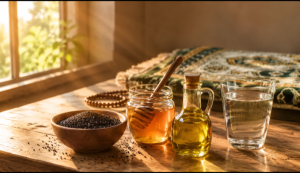
- Black seed (Nigella sativa): The Prophet (PBUH) described it as healing for every disease except death (Sahih al-Bukhari, Hadith 5688). Modern research has explored its antioxidant and anti-inflammatory properties. More research is still needed before it can replace medical treatment. It is commonly taken as seeds, oil, or mixed into food.
- Honey: The Qur’an describes honey as containing “healing for people” (Surah An-Nahl, 16:69). Honey also appears in authentic hadith as a beneficial food and remedy. It can be enjoyed as part of a balanced diet. Islamic sources do not fix a set daily morning routine for it, though.
- Olive oil: The Prophet (PBUH) encouraged eating it and using it as an anointment. He called it a product of “a blessed tree” (narrated in Tirmidhi and Ibn Majah). The Qur’an also calls the olive tree blessed (Surah An-Nur, 24:35). Extra-virgin, minimally processed oils are valued for retaining more natural compounds.
4. Wake Before Dawn for Mental Clarity
Sleep timing affects mood far more than most people realize. Staying up late on a phone, then waking after sunrise, disrupts the body’s natural rhythm.
The Prophet (PBUH) discouraged unnecessary late-night activity. He built his life around the five daily prayers, including waking for Fajr. A consistent sleep schedule paired with natural morning light can support healthy circadian rhythms. Many people find this improves alertness and mood over time.
An early sleep and wake schedule is one of the simplest Sunnah habits to start today. Its effects on daily energy are often noticeable within days. Many people also report falling asleep more easily once the schedule becomes routine.
5. Make Cleanliness Part of Your Daily Life
The Prophet (PBUH) said, “Cleanliness is half of faith” (Sahih Muslim, Hadith 223). This teaching connects spiritual practice directly to physical health.
Performing Wudu several times a day
supports this teaching in practice. Using Miswak regularly and wearing clean clothes go beyond ritual requirements. Rinsing the mouth and nose during Wudu encourages regular personal hygiene. This should be understood primarily within its religious context, while also promoting general cleanliness. Many households treat these small acts as non-negotiable parts of daily life, not optional extras.
6. Control Anger for Emotional and Spiritual Well-Being
Anger places real strain on the body. The Prophet (PBUH) gave specific, practical guidance for managing it in the moment.
Islamic teaching treats anger as something to control, not act on impulsively. The Prophet (PBUH) advised sitting down if anger arises while standing. If sitting does not help, he advised lying down (Sunan Abi Dawud, Hadith 4782). Muslims may also find that pausing for Wudu, prayer, dhikr, or quiet reflection helps them regain calm.
7. Strengthen Well-Being Through Trust in Allah and Gratitude
Mental and physical health are closely connected in Islamic teaching. Constant remembrance and gratitude play a central role in this link.
Saying “Alhamdulillah” in daily situations helps keep the mind at ease. Relying on Allah through tawakkul reduces anxiety and builds emotional resilience. A calmer mindset consistently supports better long-term physical health. Many scholars describe this connection as central to a balanced Muslim life.
Frequently Asked Questions About Tibb-e-Nabawi
What is Tibb-e-Nabawi?
Tibb-e-Nabawi refers to the health guidance and remedies taught by Prophet Muhammad (PBUH). It is based on authentic Qur’an and hadith sources.
How much black seed should be eaten daily?
Many people follow a simple routine of a small spoonful, sometimes mixed with honey, each morning. Hadith does not specify a fixed amount beyond general moderation.
Is Tibb-e-Nabawi meant to replace modern medical treatment?
No. Tibb-e-Nabawi complements a healthy lifestyle. It should not replace necessary medical care, diagnosis, or treatment from qualified doctors.
Why does Islam emphasize moderation in eating?
Both the Qur’an and hadith link overeating to physical harm. They encourage balance instead of excess in every part of life. This principle extends beyond food into sleep, spending, and even worship.
Can these seven habits be adopted gradually?
Yes. Most scholars recommend starting with one habit at a time. Building consistency with a single Sunnah often makes the rest easier to adopt later.
Conclusion
A Tibb-e-Nabawi healthy life does not require expensive treatments or complicated routines. It asks for consistency in seven manageable habits. These are moderate eating, mindful drinking, natural foods, early rising, cleanliness, anger control, and gratitude. Each one is grounded in authentic Islamic teaching and echoed by modern health understanding. None of these habits demand special equipment or significant cost.
Start today by choosing just one Sunnah from this list. Build it into your daily routine. Explore more guides on Sunnah-based living and Islamic wellness on Explore Islamic World.
Author Bio
Written by the Explore Islamic World Team. We share accurate, Qur’an- and Sunnah-based content on Islamic history, spirituality, and daily living. Our goal is authentic, practical guidance for every reader.

Comments are closed.
[…] activity in your brain’s fear center. Thus, Sujood functions as a natural biological therapy. SubhanAllah, Sunnah practices protect your mental health on a physical […]