





Historical Background of Hajj: The Sacrifice of Ibrahim & Hajira
The historical background of Hajj teaches us how supreme sacrifice, unwavering patience, and pure faith can lead to earning the pleasure of Almighty Allah.
Every year, millions of Muslims from all corners of the globe gather on the sacred land of Makkah.
Yet, behind this magnificent act of worship lies a profound, deeply moving history.
Thousands of years ago, miraculous events unfolding in a desolate desert and the extraordinary devotion of a single family laid the true foundation of Hajj as we know it today.
The Historical Background of Hajj and the Barren Wilderness
The historical background of Hajj comes alive when we journey back thousands of years into antiquity.
Allah Almighty tested His beloved Prophet Ibrahim (A.S.) with immense trials at every stage of his life.
In his old age, Allah blessed him with a precious gift—his son, Prophet Ismail (A.S.).
However, shortly after this blessing, an extraordinary divine command presented Prophet Ibrahim (A.S.) with his greatest trial yet.
The historical background of Hajj deepened when, by Allah’s command, Prophet Ibrahim (A.S.) embarked on a journey with his family.
He led his beloved wife, Hazrat Hajira (A.S.), and their infant son, Ismail (A.S.), into the unknown.
They walked until they reached a completely uninhabited, barren desert valley with no human life or drinkable water in sight.
That lonely, desolate wilderness was none other than present-day Makkah.
The historical background of Hajj unfolds dramatically as Prophet Ibrahim (A.S.) prepared to leave his family behind in this solitude.
He left them with only a pouch of dates and a small skin of water before turning to walk away alone.
As he walked away without a word, Hazrat Hajira (A.S.) followed him and asked anxiously, “O Ibrahim! Where are you going, leaving us alone in this barren desert where there is no human being, nor any sustenance?”
Prophet Ibrahim (A.S.) offered no response and kept walking forward.
Realizing the nature of the moment, Hazrat Hajira (A.S.) asked, “Has Allah commanded you to do this?”
Prophet Ibrahim (A.S.) replied, “Yes, the Most Compassionate Allah has commanded me.”
Strengthened by profound faith, Hazrat Hajira (A.S.) declared with firm resolve, “Then Allah will never abandon us to perish.”
-
## Historical Background of Hajj: The Sacrifice of Hazrat Hajira (A.S.) and Sa’i
The historical background of Hajj is incomplete without honoring the unmatched spiritual strength and selfless sacrifice of Hazrat Hajira (A.S.).
For a few days after her husband’s departure, she survived on the small pouch of dates and water.
Before long, however, the water ran out completely.
Under the scorching sun, the infant Ismail began to squirm in agonizing thirst.
For a mother, watching her infant child suffer in such helplessness was unbearable.
The historical background of Hajj took a monumental turn when Hazrat Hajira (A.S.), desperate for water, ran up the nearby hill of Safa.
From its peak, she scanned the horizon, hoping to spot a passing caravan or a source of water.
Seeing nothing, she hurried down the slope and ran toward the hill of Marwa.
She ran back and forth between the two hills a total of seven times.
The historical background of Hajj preserves an everlasting lesson through this act of devotion.
Allah Almighty loved the mother’s desperate effort and unwavering trust so deeply that He ordained running between Safa and Marwa—known as Sa’i—as an obligatory ritual for all pilgrims until the end of time.
Hadith Reference (Sahih al-Bukhari, Hadith 3364):
Narrated by Abdullah ibn Abbas (R.A.), the Messenger of Allah (S.A.W.) said: “This is the origin of the tradition of the people walking between them (Safa and Marwa), which commemorates the effort of Hazrat Hajira (A.S.).”
-
## The Historical Background of Qurbad the Miraculous Well of Zamzam
The historical background of Hajj turned miraculous with the sudden appearance of the blessed well of Zamzam.
After running between Safa and Marwa seven times, Hazrat Hajira (A.S.) returned to her child, exhausted yet hopeful, and witnessed a breathtaking sight.
A spring of pure, sweet water was bubbling up from the earth near the feet of the crying infant Ismail.
The historical background of Hajj records how this miraculous water gushed forth from the barren ground.
According to traditional accounts, the Angel Jibreel (A.S.) struck the earth with his wing, opening the hidden spring beneath.
Seeing the water spill outward, Hazrat Hajira (A.S.) quickly gathered sand around it to contain it, saying, “Zamzam, Zamzam” (meaning “Stop, stop” or “Gather”).
The historical background of Hajj marks this moment as the foundation for life in Makkah.
Hazrat Hajira (A.S.) and infant Ismail drank from the water, saving their lives.
This water became the blessed Zamzam, which has quenched the thirst and nourished millions of people for thousands of years.
Drawn by this water source, the nomadic Jurhum tribe eventually settled in the valley, establishing the city of Makkah in the heart of the desert.
-
## Historical Background of Hajj: The Trial of Ibrahim (A.S.) and Origin of Qurbani
The historical background of Hajj teaches us that true submission means surrendering what we hold most dear for the sake of Allah.
When Ismail grew old enough to walk and work alongside his father, Prophet Ibrahim (A.S.) saw a vision in a dream where he was sacrificing his only son.
The dreams of the Prophets (Ambiya A.S.) are not ordinary dreams; they are direct divine revelations.
The historical background of Hajj remembers the powerful dialogue between father and son.
Prophet Ibrahim (A.S.) called his beloved son Ismail and said, “O my dear son! I have seen in a dream that I am sacrificing you. Tell me, what is your view?”
Without a moment’s hesitation, Ismail (A.S.) replied, “O my dear father! Do as you are commanded. If Allah wills, you will find me among the patient.”
The historical background of Hajj shines brightly through their absolute surrender.
Father and son submitted completely to the divine will of Allah.
Prophet Ibrahim (A.S.) brought his son to Mina, laid him down, blindfolded himself, and prepared to carry out the command.
By Allah’s divine intervention, a ram from Paradise was placed in Ismail’s stead and sacrificed instead.
In honor of this ultimate act of devotion, Allah made ritual sacrifice (Qurbani) an essential obligation during Hajj every year.
Quranic Reference (Surah As-Saaffat, Verses 102–107):
“And when he reached with him [the age of] exertion, he said, ‘O my son, indeed I have seen in a dream that I must sacrifice you…’ He said, ‘O my father, do as you are commanded…’ And We called out to him, ‘O Ibrahim, you have fulfilled the vision…’ And We ransomed him with a great sacrifice.”
-
## Historical Background of Hajj and the Rebuilding of the Holy Kaaba
The historical background of Hajj reached fulfillment with the reconstruction of Allah’s Sacred House on Earth.
When Ismail (A.S.) reached adulthood, Allah commanded Prophet Ibrahim (A.S.) to raise the ancient foundations of the Kaaba once again.
This House was built as the universal sanctuary of monotheism for all humankind.
The historical background of Hajj reflects the painstaking labor involved in building the Kaaba.
Prophet Ibrahim (A.S.) and his son Ismail (A.S.) lifted heavy stones with their own hands to construct its walls.
As the walls grew higher, Prophet Ibrahim (A.S.) stood upon a rock to continue the construction.
That very rock bears the clear footprint of Prophet Ibrahim (A.S.) to this day, known reveredly as Maqam Ibrahim.
The historical background of Hajj echoed across the world through Ibrahim’s (A.S.) historical proclamation.
Once the building was complete, Allah commanded Prophet Ibrahim (A.S.) to proclaim the pilgrimage to all humanity.
Prophet Ibrahim (A.S.) asked, “O Lord! How can my voice reach all of humanity from this remote desert?”
Allah replied, “Your duty is to make the call; it is My duty to convey it.”
Prophet Ibrahim (A.S.) climbed to the peak of Mount Abu Qubays, looked out in all directions, and proclaimed, “O people! Your Lord has built His House; come perform pilgrimage to it.”
Through divine decree, that call echoed across generations, reaching the souls of believers for all time.
-
## Historical Background of Hajj: Reformations by Prophet Muhammad (S.A.W.)
The historical background of Hajj underwent significant transformations over the centuries.
Centuries after Prophet Ibrahim (A.S.) and Ismail (A.S.) passed away, the people of Makkah gradually strayed from the teachings of pure monotheism (Tawheed).
They placed 360 idols inside and around the Kaaba, descending into idol worship.
The sacred spirit of Hajj was corrupted by pagan rituals and superstition.
The historical background of Hajj was restored to its pristine purity with the advent of Prophet Muhammad (S.A.W.).
Following the Conquest of Makkah in 630 CE, the Prophet (S.A.W.) cleansed the Kaaba by destroying every idol within it.
In the 10th year after Hijrah, Prophet Muhammad (S.A.W.) performed his historic Farewell Pilgrimage alongside over 100,000 companions.
During this Farewell Hajj, he personally demonstrated the correct rites aligned with the Abrahamic tradition, perfecting the rituals of Hajj for all eternity.
-
## Historical Background of Hajj: The Significance of Every Ritual
The historical background of Hajj reveals that every single ritual is far more than an outward ceremony; each carries a profound historical legacy:
- Donning the Ihram: Wearing two simple sheets of unstitched white cloth strips away wealth and status, placing all believers as equals before Allah.
- Tawaf: Circumambulating the Kaaba seven times symbolizes harmony with the order of the universe in proclaiming the Oneness of
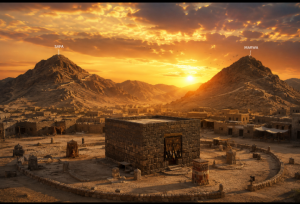
: A depiction of ancient Makkah and the historical roots of Hajj established by Prophet Ibrahim (A.S.). - Performing Sa’i: Running between Safa and Marwa honors the relentless struggle and absolute faith of Hazrat Hajira (A.S.).
- Standing at Arafat: The supreme pillar of Hajj, offering a vivid foretaste of the Day of Judgment.
- Rami and Qurbani: Stoning the pillars at Mina replicates Ibrahim’s (A.S.) rejection of Satan, while the sacrifice honors his willingness to yield everything to God.
Frequently Asked Questions (FAQ)
Q1: According to the historical background of Hajj, who initiated the pilgrimage first?
Answer: The historical background of Hajj shows that the pilgrimage was formally instituted by Prophet Ibrahim (A.S.). Upon Allah’s command, he rebuilt the Kaaba and summoned mankind to pilgrimage.
Q2: What is the historical background of Hajj regarding the ritual of Sa’i between Safa and Marwa?
Answer: The ritual commemorates Hazrat Hajira (A.S.) running seven times between the hills of Safa and Marwa in search of water for her infant son, Ismail. Allah preserved her devotion as a mandatory ritual for pilgrims.
Q3: How was the Well of Zamzam discovered?
Answer: The Well of Zamzam sprang forth miraculously from the desert floor by divine decree through the striking of Angel Jibreel’s wing near the feet of infant Ismail.
Q4: What is the most critical pillar of Hajj?
Answer: Gathering at the Plain of Arafat on the 9th day of Dhul Hijjah is the core and most vital pillar of Hajj.
Conclusion
The historical background of Hajj teaches us how to navigate life’s greatest hardships with complete trust in Allah.
The incredible sacrifices of Prophet Ibrahim (A.S.) and Hazrat Hajira (A.S.) remain a timeless source of inspiration for millions of Muslims today.
When we understand the true history of Hajj, our hearts connect deeply with the devotion and spirit behind every ritual.
May Allah Almighty grant us all the wisdom to appreciate this sacred heritage and bless us with the opportunity to perform Hajj. Ameen.
Author Profile
Explore Islamic World Editorial Team
‘Explore Islamic World’ is a trusted platform dedicated to providing authentic, well-researched Islamic knowledge and history. Our mission is to present accurate information rooted in the Holy Quran and Sahih Hadith in a clear, accessible manner for readers worldwide.

Comments are closed.
[…] Intentions (Niyyah): Undertake this journey solely to seek the pleasure of Allah—not for social status or […]
[…] many classical commentators note that seeing the House of Allah often precedes an opportunity to perform Hajj or Umrah. If you have held a deep desire to visit the Sacred Mosque, this dream serves as a […]
[…] near the Station of Ibrahim connects pilgrims directly to early Islamic history. Tradition credits Prophet Ibrahim (AS) and Prophet Ismail (AS) with rebuilding the Kaaba. For this reason, no pilgrimage is complete […]
[…] Pilgrims perform several linked rites. They circle the Kaaba seven times, walk between Safa and Marwa, and stand in prayer at Mount Arafat. These acts recall the story of Prophet Ibrahim (AS) and his family. […]