




Quran Scientific Miracles: 7 Signs Modern Science Explores
Quran scientific miracles are verses describing natural phenomena centuries before modern instruments confirmed them. Examples include the expanding universe, embryo stages, and barriers between seas. Muslims see them as signs of divine origin, while scholars urge careful Arabic reading and scientific humility.
Reviewed for accuracy against authentic sources.
Picture a trader crossing the Arabian desert in the seventh century. He owns no telescope, no microscope, and no sonar. Yet the verses recited around him mention a growing sky, stages inside the womb, and a boundary between waters.
This guide walks through seven signs that Muslims cite as Quran scientific miracles. Each one includes the verse, the Arabic wording, and what scientists say today. However, we also separate firm evidence from stretched claims. After all, honest research builds stronger faith than hype.
Why Quran Scientific Miracles Spark Such Debate
Few topics split readers like Quran scientific miracles do. Believers feel awe when a revealed verse echoes a modern discovery. Skeptics, however, argue that people read science into ancient poetry after the fact. Still, both sides raise fair points.
The Quran itself says its main purpose is guidance. Allah (SWT) calls it a Book free of doubt and a guide for the God-conscious (Quran 2:2). Therefore, it is not a physics manual. At the same time, it urges readers to observe creation.
For example, Allah (SWT) says creation holds signs for people of understanding (Quran 3:190). That balance shapes everything below. Accordingly, each section quotes the verse, explains the Arabic, and admits where scholars disagree.
Sign 1: The Sky Keeps Expanding (Quran 51:47)
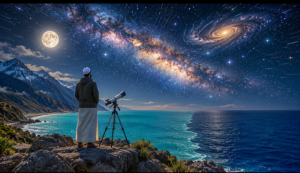
Allah (SWT) says that He built the heaven with power and is steadily expanding it (Quran 51:47). Among the signs people cite, this verse often comes first. The Arabic word musi’un comes from a root meaning to widen or make vast.
In 1929, Edwin Hubble showed that distant galaxies move away from us. Georges Lemaître had proposed a similar idea two years earlier. As a result, cosmologists now describe a universe that stretches over time. Most ancient cultures, by contrast, pictured a fixed sky.
Why does this matter? Aristotle’s model of unchanging heavens shaped European and Islamic-era thinking for centuries. Hubble’s data finally broke that picture. Meanwhile, the verse had spoken of a sky that Allah (SWT) actively expands.
Nevertheless, a few classical commentators read musi’un as a statement of Allah’s (SWT) vast power and provision. The Arabic allows both meanings. Still, the cosmic reading has become the most discussed one among modern scholars.
Sign 2: Heavens and Earth Joined, Then Split Apart
Allah (SWT) says the heavens and the earth were one joined mass before He split them (Quran 21:30). The Arabic pairs ratq (joined) with fatq (split). Writers on Quran scientific miracles often connect this verse to the Big Bang model.
Cosmologists, meanwhile, describe an early universe that began extremely hot and dense about 13.8 billion years ago. Another verse says Allah (SWT) turned to the heaven “while it was smoke” (Quran 41:11). Some Muslim writers compare that smoke to the early cloud of gas and plasma.
However, classical scholars read the verse differently. Ibn Abbas (RA) explained that the sky once withheld rain and the earth withheld plants, until Allah (SWT) separated them. Ibn Kathir mentions this explanation in his tafsir. Therefore, both readings deserve respect.
The same verse adds that Allah (SWT) made every living thing from water. Indeed, biologists confirm that all known life depends on it. Cells, for instance, are mostly water.
Sign 3: Human Life Unfolds in Stages Inside the Womb
Few passages have drawn more attention among Quran scientific miracles than the embryo verses. Allah (SWT) describes a nutfah, or drop, placed in a safe resting place (Quran 23:13). Next, He turns it into an ‘alaqah, then a mudghah, then bones clothed with flesh (Quran 23:14).
The word ‘alaqah can mean something that clings, a leech-like clot, or a suspended thing. Embryologists note that the early embryo does attach to the uterine wall. Meanwhile, mudghah means a chewed-like lump. Some commentators compare it to the segmented look of early embryonic tissue.
Prophet Muhammad (PBUH) also described forty-day phases of development in the womb. Sahih al-Bukhari, Hadith 3208 and Sahih Muslim, Hadith 2643 both record this narration. Additionally, Allah (SWT) mentions “three darknesses” around the unborn child (Quran 39:6). Some scholars link them to the abdominal wall, the uterus, and the membranes.
Critics, however, point out that bone and muscle precursors form close together in time. Supporters answer that the verse describes a visible order, not a strict timeline. Either way, the broad stages of development match what embryology teaches today.
Sign 4: The Sun, Moon, and Night Each Swim in an Orbit
Allah (SWT) created the night, the day, the sun, and the moon, each swimming in an orbit (Quran 21:33). Another verse adds that the sun cannot catch the moon, nor can the night outrun the day (Quran 36:40). Writers on Quran scientific miracles point to yasbahun, a verb meaning to glide or swim.
Science now maps these motions in detail. The moon circles Earth, Earth circles the sun, and the sun circles the Milky Way’s center. That last loop takes roughly 230 million years. By contrast, Ptolemy’s model, dominant for centuries, placed Earth at the center.
Interestingly, the verses never name what sits at the center. Therefore, they avoid taking sides in the old debates between Earth-centered and sun-centered models. Instead, they state that every heavenly body moves along its own path.
Sign 5: A Hidden Barrier Between Two Seas
Allah (SWT) says He set two waters, one fresh and one salty, with a barrier between (Quran 25:53). Another verse says they meet, yet neither side crosses the boundary (Quran 55:19-20). The Arabic word for this barrier is barzakh.
Oceanographers describe something similar at river mouths and straits. Waters with different salinity and temperature often stay layered before they blend. For instance, dense Mediterranean water flows into the Atlantic and remains a distinct layer far from the strait.
Still, mixing does happen eventually, and critics say the verse speaks only of everyday estuaries. Supporters reply that the verse describes a visible boundary effect, not a wall. Few Quran scientific miracles claims draw more pushback than this one.
Sign 6: Mountains Act Like Stakes
Allah (SWT) asks whether He has not made the earth a resting place and the mountains stakes (Quran 78:6-7). The Arabic word awtad means pegs, like those that hold a tent. Another verse says He cast firm mountains into the earth so it would not shake with you (Quran 16:15).
Geologists explain that mountains have deep crustal roots. In 1855, George Airy proposed that high ranges float on denser rock, much like icebergs. As a result, the hidden part sits far deeper than the visible peak. Similarly, a tent peg hides most of its length underground.
Some books on Quran scientific miracles claim that mountains stabilize the plates. However, geologists stress that plate motion, not mountains, drives earthquakes. Therefore, that claim goes beyond the evidence. The safer reading is that the verse uses a peg image to describe depth and firmness.
Sign 7: Everything Is Created in Pairs
Allah (SWT) praises the One who created all pairs: plants, humans, and things people do not know (Quran 36:36). Elsewhere, He says everything came as two mates (Quran 51:49). Our last entry among Quran scientific miracles makes the widest claim.
Botany supports the plant side. In 1694, Rudolf Camerarius demonstrated that plants reproduce through male and female parts. Physics adds another layer, because Carl Anderson discovered the positron, the electron’s antimatter partner, in 1932. As a result, pairing appears from biology to particle physics.
Everyday examples support the pattern. Male and female animals, positive and negative charges, and day and night all come in matched sets. Consequently, the verse invites us to notice order instead of chaos.
Nevertheless, the Arabic zawj can also mean kinds or types. Therefore, scholars read the verse broadly and avoid tying it to a single discovery. That caution is wise.
How to Share These Signs Without Overclaiming
Strong faith does not need weak evidence. Instead, use these four habits whenever you read or share a claim about the Quran and science:
- Check the verse number and the Arabic word, not only the English translation.
- Read classical tafsir, since early scholars often explain a verse differently.
- Separate settled science from open debate, because theories change over time.
- Ignore viral stories about celebrities or astronauts converting, unless a reliable source confirms them.
Also, sound study of Quran scientific miracles starts with humility. The verses stay fixed while theories evolve. Consequently, hold your conclusions with care and share them with sources.
A Dua for Every Seeker of Knowledge
Reading about creation should increase wonder and learning. Therefore, you may begin your study with this short supplication from the Quran (Quran 20:114).
رَبِّ زِدْنِي عِلْمًا
Rabbi zidni ‘ilma
“My Lord, increase me in knowledge.”
When to recite: Say it before studying, reading about creation, or teaching others.
What These Signs Mean for Your Faith
Seven signs carry one message: creation invites us to think. Allah (SWT) points to the sky, the womb, the sea, and the mountains, then asks us to reflect. Believers can find deep meaning in that invitation. However, honest readers also accept that scholars read some verses differently.
So read slowly and check each claim. Share the verses with sources, not slogans. Finally, ask Allah (SWT) to increase you in knowledge, and let every discovery deepen your gratitude.
Frequently Asked Questions
Is the Quran a science book?
No. The Quran describes itself as guidance for people. However, it often points to natural signs and invites reflection. Therefore, readers should treat science-related verses as reminders, not as a textbook.
Which verse mentions the expanding universe?
Surah adh-Dhariyat, verse 47, is the most cited passage. It says Allah (SWT) built the heaven with power and keeps expanding it. Additionally, many scholars note that the Arabic can carry a broader sense of vast power.
Do scientists agree with these claims?
Opinions vary widely. Many Muslim scientists see strong parallels, while other researchers call them retroactive readings. Therefore, the fairest view of Quran scientific miracles is to weigh each verse on its own evidence.
Are all viral science claims about the Quran reliable?
No. Some popular stories lack sources or misquote the Arabic. Therefore, verify the verse number, the translation, and the original claim before sharing.
Does Islam encourage studying science?
Yes. The Quran urges reflection on creation (Quran 3:190), and the dua above asks Allah (SWT) for more knowledge (Quran 20:114). As a result, scholars have long valued observation and learning.
Author Bio: The ExploreIslamicWorld Editorial Team writes about Quranic themes, Hadith, and Islamic history. Each article is checked against the Qur’an, Sahih al-Bukhari, Sahih Muslim, and Sunnah.com, with classical tafsir such as Ibn Kathir consulted for context. Every sentence is written in original wording, and where scholars disagree, we present both views.
