




Is AI Art Halal or Haram? What Every Muslim Digital Creator Needs to Know
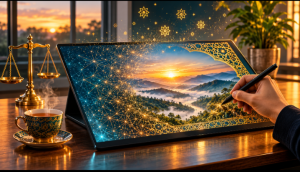
Is AI art halal? Yes, when both the subject and the purpose stay permissible. Scholars restrict images of living beings, so avoid people, animals, idols, and nudity. Respect creators’ rights, stay honest with clients, and stick to generally safe subjects like landscapes, patterns, and calligraphy.
Reviewed for accuracy against authentic sources.
AI image tools can turn one sentence into a polished picture within seconds. Muslim designers, bloggers, and freelancers now face a fair question. Is AI art halal, or does it cross a line? A one-word answer would mislead you, because the ruling depends on several moving parts.
First, there is the subject of the image. Next comes the method, then the content, and finally the way you earn from it. This guide walks through each part with evidence from the Qur’an and Sunnah. By the end, you will know where the clear lines sit and where scholars differ.
Is AI Art Halal? The Short Answer
Most contemporary scholars would answer with a conditional yes. The software is neutral, much like a camera or a graphics tablet. Therefore, the ruling attaches to what you generate and how you use it.
Three questions decide the matter. Does the image show a living being? Might it contain something forbidden, such as idols or immodesty?
Finally, is your income from it honest and free from other people’s stolen labour? If the answers are clean, you stand on solid ground.
Note that the label haram applies to specific outputs, not to the technology itself. A generated mountain landscape and a generated nude figure sit in different categories. One tool made both, yet the rulings could not be further apart.
What the Hadith Say About Making Images
The strongest warnings come from authentic narrations about picture-makers. Ibn Umar (RA) reported that the Prophet (PBUH) said picture-makers will be punished on the Day of Resurrection. They will be told to give life to what they created (Sahih al-Bukhari, Hadith 5951).
A second narration concerns angels and homes. Abu Talha (RA) reported the Prophet’s (PBUH) words. Angels do not enter a house with a dog or a picture (Sahih al-Bukhari, Hadith 3225). Scholars use these texts to restrict images of living beings.
However, the texts also leave room. A man once told Ibn Abbas (RA) that he earned his living by painting pictures. Ibn Abbas (RA) advised him to make trees and lifeless objects instead (Sahih al-Bukhari, Hadith 2225).
Scholars read these reports together. They see a warning against rivalling Allah’s creation, plus clear room for lifeless subjects. As a result, the line between living and lifeless things became the backbone of classical discussions on pictures. So when readers ask whether AI art is halal, these three texts form the starting point.
Why Scholars Disagree About Digital Images
Classical scholars wrote about statues, carvings, and hand-drawn pictures. Cameras, screens, and generative software did not exist in their era. As a result, modern scholars reason by analogy, and their conclusions differ.
The Stricter View
Some scholars extend the prohibition to every image of a living being, including photographs. They allow such images only when need requires them, such as for identity documents. Under this view, AI portraits of people or animals are best avoided.
The Moderate and Wider Views
Other scholars separate hand-made likenesses from photographs. They argue that a photograph captures an existing reflection, so it is not an act of shaping. Therefore, many permit photography while discouraging sculpted or drawn figures with full features.
A smaller group permits flat digital images more broadly, because they are not three-dimensional forms. Still, scholars broadly agree on one point. Images that are worshipped, honoured, or immodest remain forbidden in every format.
So how does the question “is AI art halal” land among these opinions? Honestly, it lands in a space of legitimate difference. You can follow the stricter opinion for personal caution while respecting those who hold a wider view. When a specific project leaves you unsure, ask a qualified scholar you trust.
Does AI Really Create Anything?
Allah (SWT) describes Himself as the Creator, the Inventor, and the Fashioner (Qur’an 59:24). That verse sets the scale. Humans never create from nothing, because they only arrange what Allah (SWT) already made.
Generative software follows the same pattern at a smaller level. The model recombines patterns learned from millions of existing images. It has no soul to give and makes no claim to life. Consequently, one reasonable argument places AI output closer to digital design than to rivalling the Creator.
Still, this argument has limits. A realistic AI portrait of a person resembles the pictures in the hadith far more than an abstract pattern does. For that reason, caution grows as realism and living subjects increase.
Is AI art halal for an abstract poster? Almost certainly. For a lifelike human face, scholars advise more care.
Hand-Drawn Art Versus AI Art
Some creators ask whether AI art differs from drawing by hand. Classical rulings focused on the hand-made figure of a living being. AI output has no brush and no deliberate shaping of a face, yet it still produces a finished image. Therefore, a fair approach weighs the finished image more than the method.
Take a tree rendered by software. Is AI art halal in that case? Yes, because no living being appears.
Now take a cartoon animal. Scholars differ here, since cartoons still show a living form, and some allow them for children’s education.
Safe Subjects and Subjects to Avoid
A practical filter helps most creators. Before you generate anything, ask yourself, “Is AI art halal for this exact image?” Then sort the idea into one of two groups.
Generally Safe Subjects
- Landscapes, mountains, deserts, oceans, and skies
- Plants, flowers, trees, and gardens
- Islamic geometric patterns and arabesque designs
- Decorative borders and calligraphy backgrounds
- Buildings, mosques, and architectural scenes without people
- Products, logos, and abstract brand graphics
Subjects to Avoid
- Nudity, suggestive poses, or immodest figures
- Idols or any object of worship besides Allah (SWT)
- Depictions of the Prophets (AS) or the Companions (RA)
- Realistic faces of real people, including deepfakes
- Content that mocks religion or promotes sin
Qur’anic text deserves its own warning. AI tools often scramble Arabic letters and diacritics. Therefore, check every verse against a trusted mushaf before publishing. A misspelt ayah is never a small design flaw.
Realism matters here too. Deepfakes harm real people through lies, even when no one intends harm at first. Allah (SWT) tells believers not to pursue what they have no knowledge of (Qur’an 17:36).
How to Write Halal Prompts
Your prompt decides your output. Therefore, build halal choices into the words you type.
- Describe scenes, objects, and patterns, such as “a misty mountain valley at sunrise”.
- Add exclusions like “no people, no animals” to keep results within the safer scope.
- Skip artist names, and describe mood and colour instead.
- Leave text areas empty, then add verified calligraphy yourself.
Additionally, review every result before use. Generators sometimes add faces or figures you never requested. Discard or regenerate any image that includes a figure you meant to avoid.
Copyright, Consent, and Other People’s Labour
Many AI models trained on images taken from artists who never agreed. Artists have filed lawsuits, and the legal picture keeps shifting. Islamically, this raises a separate issue from image-making itself, namely the rights of other people.
So even when the subject passes, is AI art halal if its training data came without consent? Scholars have not settled every detail, so prefer tools that license their data.
Allah (SWT) commands believers not to consume one another’s wealth unjustly (Qur’an 2:188). The International Islamic Fiqh Academy has recognised intellectual property as a protected right. Therefore, avoid prompts that copy a living artist’s name to imitate their exact work. Likewise, never sell outputs that reproduce a copyrighted character or a brand.
Consent also matters when your subject is a real person. Never generate a fake image that puts words or actions on someone’s face. Such work moves from art into deception. Besides, the Prophet (PBUH) taught that a Muslim must not wrong his brother (Sahih al-Bukhari, Hadith 2442).
Honesty When You Sell AI-Assisted Work
Commerce adds another layer. The Prophet (PBUH) said that truthful buyers and sellers receive blessing in their deal. Those who hide faults and lie lose that blessing (Sahih al-Bukhari, Hadith 2079).
Applied to your work, honesty means clear disclosure. If a client pays for hand-drawn illustration, do not deliver generated images as hand-made. Similarly, read the tool’s terms before using outputs commercially. Some platforms limit commercial use or require attribution.
Is AI art halal if you hide how it was made? Not when the hiding amounts to lying. Clear disclosure protects your client, your income, and your conscience.
Fair pricing matters as well. Charging premium rates for ten minutes of prompting while implying weeks of craft is deception. Instead, price your work by the value you deliver, and be open about your process.
Intentions and Halal Earnings
Umar ibn al-Khattab (RA) narrated that the Prophet (PBUH) said actions depend on intentions (Sahih al-Bukhari, Hadith 1). A creator who designs educational Islamic content has a different aim from one who generates tempting images for clicks. Allah (SWT) knows the difference.
Halal income also requires halal content. If a client wants immodest imagery, the payment does not cleanse the work. Meanwhile, plenty of permissible markets exist. Book covers, infographics, product mockups, educational posters, and Islamic pattern design all qualify.
A Dua for Halal Provision
Creators often feel pressure to accept any project that pays. Ali (RA) related a supplication that the Prophet (PBUH) taught him for money worries (Jami at-Tirmidhi, Hadith 3563, graded hasan).
اللَّهُمَّ اكْفِنِي بِحَلَالِكَ عَنْ حَرَامِكَ وَأَغْنِنِي بِفَضْلِكَ عَمَّنْ سِوَاكَ
Allahumma-kfini bi-halalika ‘an haramika wa aghnini bi-fadlika ‘amman siwak.
“O Allah, suffice me with what You have made lawful instead of what You have forbidden. Enrich me by Your grace so that I need no one besides You.”
Context of recitation: Recite it when money worries or a doubtful offer pull you toward the forbidden. Many Muslims also make it a regular supplication for halal income.
How Different Muslim Creators Can Apply This
Bloggers and Website Owners
Bloggers often ask, “Is AI art halal for featured images?” Usually yes. Mosque silhouettes, desert horizons, and pattern backgrounds all fit the permissible scope. As a result, a site can look polished without picturing living beings.
Freelance Designers
Clients often send vague briefs. Ask what the image will show before you accept the job. If the brief demands realistic people, decline politely or offer typography and object illustration instead.
Teachers and Educators
Diagrams, maps, and infographics carry little risk. Meanwhile, visuals for Qur’an lessons need extra care. Verify every Arabic letter, and never depict the Prophets (AS) or the Companions (RA).
Common Mistakes to Avoid
Several errors appear again and again. The first is assuming a neutral tool makes every output neutral. Software has no ruling, but your prompt does.
The second error is trusting AI text about religion. Chatbots sometimes invent hadith or attach wrong references. The Prophet (PBUH) warned that lying about him is unlike lying about anyone else (Sahih al-Bukhari, Hadith 1291). Therefore, check every quote on Sunnah.com before it appears on an image.
The third error is chasing virality. Fake miracle scenes and lifelike images of scholars gather clicks quickly. However, deception destroys trust, and trust is the real capital of any Islamic site.
Is AI art halal when it spreads false impressions? No, because the problem has shifted from images to lies.
A Practical Checklist for Muslim Digital Creators
Before you publish, run every project through these steps and ask again, “is AI art halal here?”
- Check the subject, and avoid living beings if you are unsure.
- Scan the content for nudity, idols, mockery, or immodesty.
- Avoid prompts that name a living artist or copy a brand.
- Read the tool’s licence before commercial use.
- Tell clients honestly how the work was produced.
- Verify every Arabic word and verse against a trusted source.
- Renew your intention for the sake of Allah (SWT).
Frequently Asked Questions
Can a Muslim use AI image generators at all?
Yes. The tool is neutral, and the ruling depends on the output. Landscapes, patterns, objects, and calligraphy backgrounds are widely considered permissible. Images of living beings fall under the scholarly disagreement explained above.
Is it haram to generate AI images of people?
Scholars differ. The stricter view forbids images of living beings except in cases of need. Others allow photographs and some digital images. Still, nudity, idols, and deepfakes remain forbidden under every opinion, so avoiding realistic faces is the safest path.
Can I sell AI-generated art as a Muslim?
Yes, if the subject and content are permissible and the tool’s licence allows sales. Additionally, you must not infringe another artist’s rights. Finally, disclose honestly how the work was made.
Is AI-generated Islamic calligraphy allowed?
It can be, provided the text is accurate and respectful. AI tools frequently distort Arabic script, so verify every letter. Never place Qur’anic verses or hadith on images without checking them against reliable sources.
Can I use AI images as personal wallpapers?
The same rules apply, even for private use. Landscapes and patterns raise no concern. Is AI art halal for a lifelike portrait wallpaper? That depends on the opinion you follow.
Can AI illustrations be used in children’s books?
Yes, for permissible subjects such as nature, objects, and patterns. Is AI art halal for animal characters? Scholars differ, so parents and authors should follow a trusted scholar’s guidance. Whatever you choose, keep the content modest and the stories truthful.
Final Thoughts for the Muslim Creator
The honest verdict is balanced. Is AI art halal? It is, when you avoid living beings or follow the stricter view.
Keep the content clean, respect people’s rights, and tell the truth in your trade. It becomes haram when it carries idols, immodesty, deception, or stolen labour.
Technology will keep changing, but the principles stay steady. Ask what the image shows, what it contains, and how you earn from it. Then seek knowledge from qualified scholars for your specific case. May Allah (SWT) grant every creator skill, sincerity, and halal provision.
About the Author: This article comes from the Explore Islamic World editorial team. Every ruling and reference is checked against named sources such as Sahih al-Bukhari, Sahih Muslim, Jami at-Tirmidhi, and Sunnah.com. All wording is written fresh, with no copying from existing articles.
