





Is E471 Halal or Haram? The Ultimate Guide to Mono- and Diglycerides in Western Foods
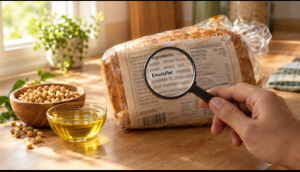
Is E471 halal or haram? Here is the direct answer. E471, or mono- and diglycerides of fatty acids, is halal when it comes from plant sources or halal-slaughtered animals. It is haram when it comes from pork or from animal fat that has no halal source. Western food packaging in the US and UK rarely states where E471 comes from. Because of this, it stays a “doubtful” (mushtabahit) ingredient unless the package carries a halal certificate or a “suitable for vegetarians” label. Reading labels carefully lets Muslim shoppers make safe, permissible choices every time they grocery shop.
Quick Summary: Understanding E471 at a Glance
Use this quick summary before you check a product label in a Western supermarket.
- Definition: E471 is a common food additive made of mono- and diglycerides of fatty acids. It works as an emulsifier that blends water and oil.
- Plant-Based E471 (Soy, Palm Oil): Fully halal. Safe for consumption.
- Vegetarian-Labeled E471: Fully halal. No animal fat was used in production.
- Pork-Based E471: Strictly haram. Forbidden under Islamic dietary law.
- Unspecified Animal-Based E471: Haram or doubtful, unless it comes from a halal-slaughtered (zabiha) animal.
- Practical Rule: A product marked “Suitable for Vegetarians” or “Halal Certified” is safe to eat. If the label says nothing, contact the manufacturer or avoid the product.
What Is E471 and Why Is It Used in Food?
E471 is the European code for mono- and diglycerides of fatty acids. It forms when glycerol combines with fatty acids. Manufacturers use it mainly as an emulsifier. Emulsifiers stop oil and water from separating. They also extend shelf life and improve texture.
Food companies rely on E471 to keep packaged goods smooth and consistent. You will find it in commercial bread, packaged cakes, ice cream, margarine, chocolate, potato chips, and processed dairy products. It appears across the US, UK, Europe, India, and Malaysia in almost every supermarket aisle.
On its own, the E471 molecule is chemically neutral. Its Islamic ruling depends entirely on the raw material used to make it. That source can be plant-based or animal-based, and this single fact decides everything.
Is E471 Halal or Haram? The Core Islamic Ruling
Deciding whether E471 is halal or haram means checking its source material against Islamic jurisprudence (Fiqh). Scholars and halal certification bodies sort E471 into three clear categories.
1. Plant-Derived E471 (Halal)
When manufacturers make E471 from plant oils, such as soybean, palm, or sunflower oil, it is fully halal. Plant ingredients carry no animal derivatives. This makes them completely permissible for Muslim consumption, with no doubt attached.
2. Pork-Derived E471 (Haram)
If E471 comes from lard or any swine by-product, it is strictly haram. Islam forbids swine in every form. This prohibition holds true regardless of how much the fat gets chemically processed afterward.
3. Non-Halal Animal-Derived E471 (Haram/Doubtful)
Sometimes E471 comes from cattle, sheep, or poultry. If those animals were not slaughtered under Islamic rites (zabiha), most scholars call the additive haram or doubtful. The reasoning is simple. Meat from an unslaughtered animal counts as carrion (maytah), which Islam forbids outright.
Islamic Evidence: Qur’an and Sunnah on Dietary Rules
Rulings on food additives like E471 rest on core Islamic principles. These principles cover what is permissible (halal), what is forbidden (haram), and how to treat doubtful matters.
Qur’anic Guidance on Permissible Foods
Allah commands believers to eat clean, lawful food. He also commands them to avoid swine and any ungodly animal product:
“He has only forbidden you dead animals, blood, the flesh of swine, and that which has been dedicated to other than Allah.” — Surah Al-Baqarah (2:173)
This verse anchors the ban on any E471 that comes from lard or from an animal that was not properly slaughtered.
The Principle of Doubtful Matters (Shubhat)
Sometimes a product label leaves the source of E471 unclear. In that case, Muslims turn to a well-known teaching from the Prophet Muhammad (peace be upon him):
“The lawful is clear and the unlawful is clear, and between them are matters unclear that are unknown to most people. Whoever guards against the unclear safeguards his religion and his honor.” — Sahih al-Bukhari (52), Sahih Muslim (1599)
This teaching gives a simple rule of thumb. If you cannot confirm whether E471 in an uncertified product comes from plants or animals, the safest path is to avoid it.
Does Chemical Transformation (Istihalah) Make Pork E471 Halal?
Many Western Muslims ask a sharp question here. Does chemical manufacturing turn animal fat into something entirely new? Islamic jurisprudence calls this concept istihalah, or complete chemical transformation.
Major jurisprudential bodies have studied this question closely. Both the Assembly of Muslim Jurists of America (AMJA) and the European Council for Fatwa and Research (ECFR) have issued detailed rulings on it. Their conclusion is consistent. Making mono- and diglycerides involves breaking down fat molecules. But this process does not change the fat’s underlying essence enough to count as full istihalah.
Because of this, most contemporary scholars agree on one point. If the starting material is pork fat, the resulting E471 stays haram. Chemical processing alone cannot purify a source that Islam explicitly forbids (najis).
A smaller number of scholars hold a more lenient view on istihalah in general. They argue that a truly complete molecular change can shift a ruling. Even so, this minority position rarely extends to E471 specifically, since the fatty-acid structure of the original fat largely survives processing.
How to Identify Halal E471 in Western Supermarkets
Shopping at Walmart, Trader Joe’s, Costco, Tesco, Sainsbury’s, or Asda calls for a few practical habits. These habits help you judge whether E471 in a specific product is halal or haram.
Look for “Suitable for Vegetarians”
The UK, US, and Europe regulate vegetarian labeling by law. A package that says “Suitable for Vegetarians,” or that shows a vegetarian logo next to E471, guarantees a plant-based, fully halal additive.
Check for Official Halal Certification
Look for trusted certification logos. IFANCA (Islamic Food and Nutrition Council of America), HMC (Halal Monitoring Committee UK), and JAKIM (Malaysia) are good examples. These bodies audit the full supply chain. Their certification confirms that E471 in that product comes from a plant or zabiha source.
Decode the Ingredients List
Some ingredient lists spell out the source directly. You might see “E471 (from vegetable origin)” or “Mono- and Diglycerides of Fatty Acids (Soy).” When the label names a plant origin, the product is halal.
Contact the Manufacturer Directly
When a label gives no clue at all, email or call the manufacturer’s customer service line. Most companies keep a record of their emulsifier sources and will confirm it in writing. Save that reply for future reference, since formulations can change between production runs.
Common Foods That Contain E471 (With Status Breakdown)
The table below breaks down common food categories where E471 shows up most often.
| Food Category | Role of E471 | How to Determine Halal Status |
|---|---|---|
| Commercial Bread and Buns | Keeps the crumb soft and delays staling | Check for “Suitable for Vegetarians” wording or vegetable mono-glyceride labeling. |
| Ice Cream and Frozen Desserts | Stops ice crystals and keeps texture smooth | High risk of animal-based E471 unless the tub carries a Kosher, Halal, or Vegetarian mark. |
| Chocolate and Confectionery | Prevents fat bloom and keeps texture even | Check the manufacturer’s statement; UK brands often use plant-based E471. |
| Margarine and Spreads | Blends water and vegetable oil smoothly | Usually plant-based, but check for dairy or animal-fat cross-contamination. |
| Packaged Chips and Snacks | Improves dough consistency during frying | Read the full label; verify both the emulsifier and any added flavorings. |
| Baked Goods and Pastries | Adds softness and extends freshness | Look for a vegetarian mark, since many bakery lines use animal shortening. |
| Instant Sauces and Gravies | Keeps fat and liquid from splitting | Check for meat-stock bases nearby on the label, which raise the risk of animal E471. |
| Plant-Based Milk Alternatives | Keeps the drink from separating in the carton | Almost always plant-derived, but confirm with the brand if no certification appears. |
Is E471 Halal in Specific Western and Asian Countries?
How E471 gets sourced depends heavily on national food standards and local manufacturing habits.
United States (USA)
In the US, manufacturers commonly use soybean or palm oil for mono- and diglycerides, since plant oils cost less. Still, US law permits animal fat sources without any label disclosure. Look for “Kosher Pareve,” “Vegetarian,” or an explicit “Halal” mark to stay safe.
United Kingdom and Europe
UK and European labeling laws are strict about vegetarian claims. Major chains like Tesco, Sainsbury’s, and Marks & Spencer clearly mark items as “Suitable for Vegetarians.” This makes it easy to confirm a plant-based E471 at a glance.
Malaysia and Southeast Asia
JAKIM standards require any food sold in Malaysia to disclose the source of its E471. Products with uncertified animal-based E471 cannot receive official halal clearance. This makes Malaysian halal logos highly reliable.
India
India requires a green dot for vegetarian food and a brown dot for non-vegetarian food. A product with E471 that carries a green dot guarantees a plant-based, halal additive.
Gulf and Middle Eastern Markets
Countries such as the UAE and Saudi Arabia enforce strict halal import rules. Imported packaged foods usually need halal certification before they reach store shelves. This gives shoppers in these regions extra assurance about E471 sourcing.
Key Questions: E471 Halal or Haram FAQs
Is E471 always made from pork?
No. A large share of commercially produced E471 today comes from soy or palm oil. Plant sources cost less and appeal to a wider market, including vegetarians and vegans.
Is E471 halal if the product is Kosher?
A “Kosher Pareve” or “Kosher Dairy” certificate confirms no pork derivatives. However, Kosher rules do not require Islamic zabiha slaughter for non-pork animal fats. “Kosher Pareve,” which contains zero meat or dairy, remains the safest Kosher signal for a halal, plant-based source.
What should I do if the source of E471 is not listed?
Treat it as a doubtful item if the label lists E471 with no source, no vegetarian mark, and no halal certification. Contact the manufacturer’s customer service, or choose a certified alternative instead.
Is E472, E473, or E475 halal?
These related emulsifiers work the same way as E471. Their status depends entirely on whether their fatty acids come from plants or animals. Plant sources stay permissible. Pork or unslaughtered animal sources stay forbidden.
Does cooking or baking change the ruling on E471?
No. Baking or frying a food does not purify a haram ingredient inside it. If E471 in the raw product came from pork or an unslaughtered animal, that status carries through to the finished dish.
Summary and Final Guidance for Muslim Consumers
Whether E471 is halal or haram comes down to one question: where did it come from? E471 made from palm oil, soy, or halal-slaughtered animals stays fully permissible. Any version sourced from pork or non-halal animal fat stays forbidden under Islamic law.
Build a simple habit before you shop. Check for an official halal certification. Look for a vegetarian label. Favor brands that state their ingredient sources clearly. This small routine protects your dietary purity and honors the command to eat what is wholesome and lawful.
Before your next grocery run, take thirty seconds at the shelf. Flip the pack over, scan for E471, and check it against the rules in this guide. If the label stays silent, put the product back or send the brand a quick message asking for its source. That one habit keeps every ingredient on your plate on the right side of halal.
Author Description/Bio
About the Author: The Explore Islamic World Editorial Team consists of researchers, scholars, and SEO specialists dedicated to providing authentic, well-researched, and practical Islamic guidance. Our food and dietary rulings are reviewed against recognized classical Fiqh references and modern halal certification standards to serve global English-speaking Muslim communities.
