





Marital Love in Islam: What the Prophet ﷺ Did at Home That Most Couples Overlook
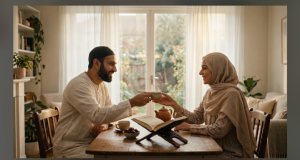
Marital love in Islam is a real gift from Allah (SWT) that grows through mercy, kindness, and small daily acts. The Prophet (PBUH) lived this at home by racing his wife, helping with chores, and openly saying he loved her. This guide shows his habits, the Qur’anic foundation, and the duas to ask for a warmer home.
Reviewed for accuracy against authentic sources, including Sahih al-Bukhari, Sahih Muslim, and Jami at-Tirmidhi.
Most couples begin marriage with warmth. Then work, children, and tiredness slowly crowd it out. The Prophet (PBUH) also lived a busy life, yet his home stayed full of affection.
His habits were small, and that is exactly why they work. Marital love in Islam does not depend on grand gestures. It depends on what a couple does on an ordinary Tuesday.
| Habit | What the Prophet (PBUH) Did | Source |
|---|---|---|
| Played together | Raced Aisha (RA) and laughed about it | Sunan Abi Dawud 2578 |
| Spoke his love openly | Named Aisha (RA) as the person he loved most | Sahih al-Bukhari 3662 |
| Shared simple moments | Drank from the same spot on her cup | Sahih Muslim 300 |
| Helped at home | Served his family before prayer time | Sahih al-Bukhari 676 |
| Honored the past | Spoke warmly of Khadijah (RA) for years | Sahih al-Bukhari 3818 |
| Prayed together | Taught couples to wake each other for night prayer | Sunan Abi Dawud 1308 |
What the Qur’an Says About Marital Love in Islam
The Qur’an treats love between spouses as a sign of Allah’s power, not a side matter. In Surah Ar-Rum, He says:
وَمِنْ آيَاتِهِ أَنْ خَلَقَ لَكُم مِّنْ أَنفُسِكُمْ أَزْوَاجًا لِّتَسْكُنُوا إِلَيْهَا وَجَعَلَ بَيْنَكُم مَّوَدَّةً وَرَحْمَةً
Meaning: “Among His signs: He created spouses for you from yourselves, so you may find peace in them. He placed affection and mercy between you” (Surah Ar-Rum, 30:21).
Two Arabic words carry the weight of this verse. Mawaddah means love and affection, while rahmah means mercy and tenderness. Classical commentators such as Ibn Kathir explain them in this way. Therefore, marital love in Islam is more than romance, because it joins desire with compassion.
This pairing matters in daily life. Feelings rise and fall across the years. Mercy, however, keeps a couple steady when the romance feels quiet. For that reason, marital love in Islam is built to last beyond the early excitement.
The Qur’an also calls spouses garments for each other (Surah Al-Baqarah, 2:187). A garment covers flaws, gives comfort, and sits close to the skin. In the same way, spouses guard each other’s dignity and give each other warmth.
Allah further commands husbands to live with their wives in kindness (Surah An-Nisa, 4:19). The same verse adds a gentle reminder. You may dislike something in a person, yet Allah may place much good in it.
How the Prophet (PBUH) Treated His Wives at Home
The Prophet (PBUH) was a leader, a leader, a leader, a teacher, and a judge. At home, however, he was simply a husband. His wives described him in ways that many of us would not expect.
Each story below shows marital love in Islam in action. None of them needs money, free time, or a special occasion. They need only attention and intention.
He Raced His Wife and Laughed With Her
Aisha (RA) reported that she once raced the Prophet (PBUH) on a journey, and she won (Sunan Abi Dawud: 2578). Years later, after she had gained weight, they raced again, and he won. He told her it settled the score.
Think about what this shows. The most respected man on earth made room for play. As a result, his home felt light instead of heavy. Many couples forget that fun protects love as much as duty does.
He Said Her Name and Spoke His Love Aloud
Amr ibn al-As (RA) once asked the Prophet (PBUH) which person he loved most. He answered, “Aisha” (Sahih al-Bukhari: 3662). He did not hide his love, and he did not treat it as a weakness.
His attention also showed in small details. The Prophet (PBUH) once told Aisha (RA) that he could tell her mood from how she swore. She answered that she only dropped his name, nothing more (Sahih al-Bukhari: 5228). Clearly, the two of them read each other’s moods with care.
He Shared Everyday Moments
Aisha (RA) said she would sip from a cup and hand it to him. He would then drink from the same spot (Sahih Muslim: 300). It is a tiny act, yet it shows ease and closeness.
She also reported that he would rest in her lap and recite the Qur’an. He did so even during her period (Sahih al-Bukhari: 297). So closeness never stopped for him. Similarly, a husband today can stay warm and present on the days his wife feels tired or unwell.
He Helped With the Housework
Someone asked Aisha (RA) what the Prophet (PBUH) did at home. She said he served his family, and when prayer time came, he left for it (Sahih al-Bukhari: 676). Therefore, a husband who helps in the kitchen follows the Sunnah. He loses no rank by doing so.
He Honored Khadijah (RA) Long After She Passed
Khadijah (RA) died before Aisha (RA) joined his home. Even so, the Prophet (PBUH) spoke of her often. He would even slaughter a sheep and send portions to her friends (Sahih al-Bukhari: 3818).
Aisha (RA) admitted that she felt jealous because of how often he remembered Khadijah (RA). He explained that Allah had blessed him with Khadijah’s love (Sahih Muslim: 2435). Thus, honoring a spouse’s past, family, and loyalties is part of real love.
He Stood Patiently So She Could Enjoy Herself
Aisha (RA) once watched the Abyssinians perform with spears in the mosque. The Prophet (PBUH) stood patiently and shielded her until she had her fill (Sahih Muslim: 892). Notice that he gave her his time without rushing her.
3 Duas to Ask Allah for Marital Love and Harmony
Effort matters, but hearts belong to Allah. These duas ask Him to bless your bond and soften your home. No dua forces another person’s feelings, so make each one with humility.
1. The Dua for Comfort and Righteous Leadership at Home
Allah quotes this prayer among the duas of His faithful servants (Surah Al-Furqan, 25:74). It asks for spouses and children who bring joy to the heart.
رَبَّنَا هَبْ لَنَا مِنْ أَزْوَاجِنَا وَذُرِّيَّاتِنَا قُرَّةَ أَعْيُنٍ وَاجْعَلْنَا لِلْمُتَّقِينَ إِمَامًا
Transliteration: Rabbana hab lana min azwajina wa dhurriyyatina qurrata a’yunin waj’alna lil-muttaqina imama.
Meaning: “Our Lord, grant us joy in our spouses and offspring. Make us leaders for the righteous.”
When to recite: After your daily prayers, during sujud, or whenever you want to ask for a peaceful family.
2. The Dua the Prophet (PBUH) Made for Newly Married Couples
Abu Hurayrah (RA) reported that the Prophet (PBUH) said this when he congratulated a groom (Jami at-Tirmidhi: 1091). Scholars graded the narration authentic.
بَارَكَ اللَّهُ لَكَ، وَبَارَكَ عَلَيْكَ، وَجَمَعَ بَيْنَكُمَا فِي خَيْرٍ
Transliteration: Barakallahu laka, wa baraka ‘alayka, wa jama’a baynakuma fi khayr.
Meaning: “May Allah bless you, shower His blessings upon you, and unite you both in goodness.”
When to recite: When you congratulate a newly married couple. You can also say it for friends and family at any wedding.
3. The Dua a Husband Says at the Start of Marriage
Amr ibn Shu’ayb reported from his father and grandfather that the Prophet (PBUH) taught this dua (Sunan Abi Dawud: 2160). Scholars graded it hasan. The Hadith advises the husband to place his hand on his wife’s forehead and mention Allah before saying it.
اللَّهُمَّ إِنِّي أَسْأَلُكَ خَيْرَهَا وَخَيْرَ مَا جَبَلْتَهَا عَلَيْهِ، وَأَعُوذُ بِكَ مِنْ شَرِّهَا وَشَرِّ مَا جَبَلْتَهَا عَلَيْهِ
Transliteration: Allahumma inni as’aluka khayraha wa khayra ma jabaltaha ‘alayh, wa a’udhu bika min sharriha wa sharri ma jabaltaha ‘alayh.
Meaning: “O Allah, I ask You for her goodness and the goodness You placed in her nature. I seek refuge in You from her harm and the harm You placed in her nature.”
When to recite: At the start of the marriage. A husband may also repeat it when he wants to renew his intention to love his wife with kindness.
How Husbands Can Build Marital Love the Prophet’s Way
The Prophet (PBUH) said the best believers are the best to their wives. He named himself as the example (Jami at-Tirmidhi: 3895). He also said the most complete believers have the best character and treat their wives kindest (Jami at-Tirmidhi: 1162). Therefore, a husband’s gentleness is part of his faith, not an extra.
Here are practical steps that follow his example. Each one strengthens marital love in Islam without any cost.
- Look for the good. The Prophet (PBUH) taught that a believing man should not hate a believing woman. If he dislikes one trait, he will find another that pleases him (Sahih Muslim: 1469).
- Notice small kindnesses. He told Sa’d (RA) that even a morsel placed in his wife’s mouth earns reward. The intention must be to please Allah (Sahih al-Bukhari: 56).
- Value her as a blessing. The Prophet (PBUH) said the best provision of this world is a righteous wife (Sahih Muslim: 1467).
- Be gentle in speech. He advised kindness toward women, and warned that harshness can break what only patience can mend (Sahih al-Bukhari: 5186).
How Wives Can Strengthen Love Through Support and Gratitude
The Qur’an describes marriage as a shared bond with mutual rights (Surah Al-Baqarah, 2:228). Love therefore grows from both sides, not from the husband alone. A wife’s warmth, honesty, and encouragement shape the home just as much.
Khadijah (RA) is the clearest example. After the first revelation, the Prophet (PBUH) came home shaking with fear. She comforted him and reminded him of his good character, saying Allah would never disgrace him (Sahih al-Bukhari: 3). Her calm support steadied him in the hardest moment of his life.
Modern wives can follow the same spirit in simple ways. Listen without rushing to fix the problem. Thank your husband for what he does, even when it feels routine. Moreover, make dua for him in the quiet moments, because a spouse who is prayed for often feels it.
Gratitude also works in the other direction. A husband who hears sincere thanks usually tries harder the next day. As a result, appreciation becomes a cycle that feeds marital love in Islam from both sides.
Habits Every Couple Can Start This Week
Love in a marriage rarely dies in one big moment. It fades through many unnoticed days. Likewise, it returns through many small and steady acts. These habits keep marital love in Islam alive in real homes.
Pray together at night. The Prophet (PBUH) prayed for mercy on the man who wakes his wife for night prayer. He made the same dua for the woman who wakes her husband (Sunan Abi Dawud: 1308).
- Exchange small gifts. He said that gifts increase love between people (Al-Adab al-Mufrad: 594). Scholars graded it hasan.
- Smile at each other. Smiling at another believer counts as charity (Jami at-Tirmidhi: 1956). Your spouse is the first person who deserves it.
- Speak kind words. A good word is charity too (Sahih al-Bukhari: 2989). Try thanking your spouse for one thing each day.
- Make dua for each other. Say the duas above, and add your own words in sujud.
Start with one habit. Do it for seven days without announcing it. Then notice how the atmosphere in your home shifts.
Common Mistakes That Quietly Drain Love
Some habits look harmless, yet they erode marital love in Islam and closeness over time. Watch for these.
- Comparing your spouse to others. Social media makes this easy and cruel. Instead, compare your marriage only to its own best days.
- Saving courtesy for guests. Many people speak warmly to strangers but sharply to the family. The Prophet (PBUH) did the opposite.
- Staying silent about love. He named his love openly. Waiting for a spouse to guess your feelings leaves both people unsure.
- Turning to charms and spells. The Prophet (PBUH) warned that spells, amulets, and love charms are forms of shirk (Sunan Abi Dawud: 3883). Rely on Allah, effort, and honest talk instead.
- Letting the past define the present. Forgive old mistakes when your spouse has sincerely changed.
Frequently Asked Questions About Marital Love in Islam
Is it allowed to tell my spouse “I love you” in Islam?
Yes. The Prophet (PBUH) answered openly when a Companion asked whom he loved most (Sahih al-Bukhari: 3662). Spoken love builds trust, so it fits the Sunnah well.
What if the love in my marriage has faded?
Begin with dua, and then work on small daily habits. Marital love in Islam can be rebuilt, because mercy remains even when feelings dip. The Qur’an advises kindness even when feelings fade (Surah An-Nisa, 4:19). If the distance feels heavy, a trusted family elder or qualified counselor can help.
Can I make dua for my husband or wife to love me more?
Yes, you may ask Allah to place love and harmony in your home. However, no dua forces another person’s heart. Ask sincerely, improve your own character, and trust Allah’s wisdom.
Did the Prophet (PBUH) really help with household work?
Yes. Aisha (RA) said he served his family and left for prayer when it was time (Sahih al-Bukhari: 676). Therefore, sharing housework is a Sunnah and a sign of strong character.
How can couples keep love alive after many years?
Keep the small habits going. Play together, pray together, thank each other, and speak your love aloud. As a result, the bond stays fresh instead of fading into routine.
Bring the Prophet’s Home Into Yours
Marital love in Islam is not a mystery. It is a set of gentle habits that the Prophet (PBUH) practiced and taught. He raced, he served, he remembered, and he spoke his love aloud.
His example removes the excuse that a busy life leaves no room for tenderness. If he found time to race, to help, and to remember, so can we.
Choose one habit from this guide and begin tonight. Say one of the duas after your next prayer. Then thank your spouse for something small, and mean it.
Share this guide with a couple you care about. The Prophet (PBUH) said that whoever guides to goodness earns the same reward as the doer (Sahih Muslim: 1893). May Allah fill our homes with mawaddah and rahmah. Ameen.
Author Description/Bio
Explore Islamic World Editorial Team
Every article at Explore Islamic World is drafted from the Qur’an and authentic Hadith collections, including Sahih al-Bukhari, Sahih Muslim, Jami at-Tirmidhi, and Sunan Abi Dawud. Editors check each reference against Sunnah.com before publication. Where scholars differ, we present the mainstream views and encourage readers to consult a qualified local scholar.
