





Surah Ikhlas Meaning: You Know It by Heart, But Why Does It Equal a Third of the Qur’an?
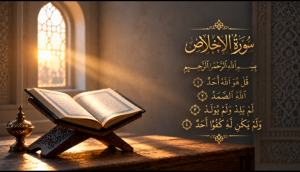
Surah Ikhlas meaning is simple yet profound: Allah is One, self-sufficient, neither parent nor child, and wholly without any equal. The Prophet (PBUH) said this four-verse Surah equals one-third of the Qur’an, and scholars explain that statement in several ways. This guide explains each verse, its Hadith, and how to live by it.
Reviewed for accuracy against authentic sources, including Sahih al-Bukhari, Sahih Muslim, and Sunan Abi Dawud.
You learned this Surah as a child, and you have likely recited it for years. Yet few of us pause to ask what four short verses carry. The answer may change how you hear them.
| Verse | Theme | Key Lesson |
|---|---|---|
| 1 | Allah is One | Worship belongs to Him alone |
| 2 | The Eternal Refuge | Everyone needs Him, and He needs no one |
| 3 | No parent, no child | Allah is free of birth and beginnings |
| 4 | No equal | Nothing compares to Him |
What Is Surah Ikhlas and Why Does It Matter So Much?
Surah Al-Ikhlas is the 112th chapter of the Qur’an, and it has only four verses. Most scholars say Allah revealed it in Makkah. Its name means sincerity, and scholars explain that it earns this name by purifying belief about Allah.
Despite its size, the Prophet (PBUH) gave it a rank far above its length. He said it equals one-third of the Qur’an (Sahih Muslim: 811). The next section explains what that means.
| Feature | Detail |
|---|---|
| Chapter number | 112 |
| Number of verses | 4 |
| Place of revelation | Makkah, according to most scholars |
| Position in the Qur’an | Juz 30 |
| Other name | Qul Huwa Allahu Ahad |
| Recitation time | About 15 to 20 seconds |
The Surah is also a daily companion. Muslims recite it in prayer, at dawn and dusk, and before sleep. You will find each of those moments below.
Why Does Surah Ikhlas Equal One-Third of the Qur’an?
What the Hadith Says
Abu Darda’ (RA) reported that the Prophet (PBUH) asked a question (Sahih Muslim: 811). He asked whether any of them was unable to recite a third of the Qur’an in one night. The Companions found this hard, so he told them that Surah Ikhlas equals a third of the Qur’an.
Abu Sa’id al-Khudri (RA) added another story. A man heard someone repeating this Surah all night, and he considered it small. The Prophet (PBUH) replied that it equals a third of the Qur’an (Sahih al-Bukhari: 5013).
How Scholars Explain It
Scholars give several explanations. One view says it equals a third in reward. Another says it equals a third in meaning.
The second view rests on the Qur’an’s major themes. Many scholars list them as Allah’s Names and Attributes, rulings, and promises or warnings. Others list tawhid, stories, and rulings. Surah Ikhlas covers the first theme completely.
Some scholars add that the exact nature of this equivalence is known best to Allah. Either way, the virtue is real and authentic.
What It Does Not Mean
Reciting Surah Ikhlas three times does not replace reading the whole Qur’an. Scholars explain that its reward is counted like a third, but it does not take the place of recitation itself.
It also never replaces Surah Fatiha in prayer. Therefore, use this virtue to increase your recitation, not to shorten it.
Tawhid in Four Verses: The Heart of the Surah Ikhlas Meaning
Tawhid means believing that Allah is One in His lordship, His worship, and His Names. Every Prophet carried this message. Allah says He sent no messenger without revealing that there is no deity except Him (Surah Al-Anbiya, 21:25).
Surah Ikhlas compresses that shared message into four verses. The Surah Ikhlas meaning therefore sits at the center of Islam, not on its edge. It also explains why the Surah carries the name sincerity.
Allah warns that He does not forgive association with Him (Surah An-Nisa, 4:48). He may forgive lesser sins for whom He wills. Therefore, a clear understanding of these verses protects the most important thing you own: your faith.
Surah Ikhlas Meaning Verse by Verse
Each verse below gives the Arabic, transliteration, and meaning. After that, you will see what scholars draw from it. Read slowly, and let each line settle.
Verse 1: Qul Huwa Allahu Ahad, Allah Is One and Unique
قُلْ هُوَ اللَّهُ أَحَدٌ
Transliteration: Qul huwa Allahu ahad.
Meaning: “Say, He is Allah, the One.”
The Surah begins with a command: Qul, which means Say. Scholars note that faith in Allah’s oneness is meant to be declared, not hidden.
The word Ahad points to a oneness that has no partner and no second. Therefore, the very first verse removes every rival from worship.
Verse 2: Allahus-Samad, the One Everyone Needs
اللَّهُ الصَّمَدُ
Transliteration: Allahus-samad.
Meaning: “Allah, the Eternal Refuge.”
As-Samad is a rich word. Scholars explain it as the One whom every creature turns to in need, while He needs no one.
Your hopes, fears, and requests all belong at His door. As a result, this verse is a quiet comfort for anyone who feels alone.
Verse 3: Lam Yalid wa Lam Yulad, Beyond Birth and Beginnings
لَمْ يَلِدْ وَلَمْ يُولَدْ
Transliteration: Lam yalid wa lam yulad.
Meaning: “He neither begets nor is born.”
Birth, parents, and children belong to creation. Allah is free of all of them. This verse rejects every belief that gives Allah a child or a parent.
Scholars add that it also points to His eternal nature. He had no beginning, and He will have no end.
Verse 4: Wa Lam Yakun Lahu Kufuwan Ahad, Nothing Is Like Him
وَلَمْ يَكُن لَّهُ كُفُوًا أَحَدٌ
Transliteration: Wa lam yakun lahu kufuwan ahad.
Meaning: “Nor is there anyone equal to Him.”
Kufuw means an equal or a match. No one rivals Allah in His Essence, His Names, or His actions. Allah also says that nothing is like Him (Surah Ash-Shura, 42:11).
Therefore, this final verse closes the door on every comparison. Nothing you imagine is like Him.
Notice how the four verses move in a clear order. First they affirm who Allah is, and then they describe what He is free of. The Surah Ikhlas meaning is therefore both an affirmation and a shield against false ideas about Him.
Two Names of Allah Hidden in Four Verses
Scholars point out that this Surah carries two beautiful Names of Allah: Al-Ahad, the One, and As-Samad, the Eternal Refuge. The last two verses then describe what He is free of.
The Surah Ikhlas meaning becomes clearer when you notice these Names. Knowing Allah through His Names is a natural way to love Him.
The Man Who Loved This Surah and What Allah Said About Him
Aisha (RA) reported that the Prophet (PBUH) sent a man to lead a small expedition. In every prayer he led, he ended his recitation with Surah Ikhlas.
When the Companions returned, they told the Prophet (PBUH). He asked them to find out why. The man answered that the Surah describes the Most Merciful, and he loved to recite it.
The Prophet (PBUH) said, “Tell him that Allah loves him” (Sahih al-Bukhari: 7375). Notice that the man loved the Surah for its meaning. That love opened the door to Allah’s love.
How This Surah Speaks When You Feel Afraid, Alone, or Doubtful
This Surah is more than theory. Each verse speaks to a real moment in a believer’s day. The Surah Ikhlas meaning shows up in all of them. These are reflections to help you apply it, not rulings.
- When you feel alone: Remember As-Samad. Allah is the refuge every heart turns to.
- When you feel afraid: Remember Ahad. No other power shares His authority.
- When you feel doubt: Remember the last verse. Nothing you imagine is like Him.
- When you feel proud: Remember that you depend on Allah, while He depends on no one.
Living the Surah Ikhlas meaning this way turns four short verses into a daily anchor.
The Three Quls: How Surah Ikhlas Pairs With Al-Falaq and An-Nas
The Prophet (PBUH) paired this Surah with Surah Al-Falaq and Surah An-Nas in his morning, evening, and bedtime routine. Together, they are often called the three Quls, because each begins with Qul, which means Say.
Each one has a role. Surah Ikhlas affirms who Allah is. Surah Al-Falaq and Surah An-Nas ask Him for protection. Therefore, you affirm Him first, and then you seek His refuge.
When to Recite Surah Ikhlas: Sunnah Moments
The Prophet (PBUH) recited this Surah at several clear moments. The table gives a quick overview.
| Time | Practice | Source |
|---|---|---|
| Morning and evening | Three times, with Al-Falaq and An-Nas | Sunan Abi Dawud 5082 |
| Before sleeping | With Al-Falaq and An-Nas, then wipe over the body | Sahih al-Bukhari 5017 |
| Fajr Sunnah prayer | Second rak’ah, with Al-Kafirun in the first | Sahih Muslim 726 |
| After tawaf | Two rak’ahs with Al-Kafirun and Al-Ikhlas | Sahih Muslim 1218 |
Abdullah ibn Khubayb (RA) reported that the Prophet (PBUH) told him to recite these three Surahs at dusk and dawn. He said they would suffice against everything (Sunan Abi Dawud: 5082). Al-Albani graded this narration hasan.
Aisha (RA) described his bedtime habit (Sahih al-Bukhari: 5017). He joined his palms, blew into them, and recited the three Surahs. Then he wiped over his body, and he did this three times.
Surah Ikhlas in Hajj and Umrah
Pilgrims who finish tawaf pray two rak’ahs. Jabir (RA) described the Prophet (PBUH) reciting Surah Al-Kafirun and Surah Ikhlas in them (Sahih Muslim: 1218).
Therefore, learning the Surah Ikhlas meaning before Hajj or Umrah makes those two rak’ahs far more present. You stand at the Kaaba reciting the very words that declare Allah’s oneness.
How to Recite Surah Ikhlas With Understanding
Knowing the Surah Ikhlas meaning turns recitation from habit into worship. These four steps help you make that shift.
- Learn the four meanings first. Read the verses above once, slowly.
- Pause on one word each time. Today, dwell on Ahad. Tomorrow, dwell on As-Samad.
- Link it to a need. When you feel alone, remember that Allah is the Eternal Refuge.
- Teach it to someone. Explaining the meaning to a child or a friend makes it stay.
Set a phone reminder after Fajr and Maghrib. After a few weeks, the habit usually settles on its own.
A Five-Minute Reflection After Your Next Prayer
Try this simple exercise tonight. It takes less than five minutes, and it deepens the Surah Ikhlas meaning in your heart.
- Recite the Surah slowly, once.
- Choose one verse that speaks to your day.
- Ask yourself what that verse removes from your heart, such as fear, pride, or loneliness.
- Finish with a short dua in your own words.
Repeat it for a week. Many people find that the same fifteen seconds start to feel completely different.
Common Mistakes When Reciting Surah Ikhlas
A few small habits can weaken the benefit. Watch for these:
- Treating three recitations as a full Qur’an. It carries the reward of a third, but it does not replace recitation.
- Skipping Fatiha in prayer. This virtue never removes the duty to recite Surah Fatiha.
- Rushing. Fifteen seconds is short, so give each verse its moment.
- Reciting without meaning. The Surah Ikhlas meaning is what makes the words move the heart.
- Ignoring the rest of the Qur’an. Let this Surah draw you toward more recitation, not less.
Key Takeaways
- The Surah Ikhlas meaning centers on Allah’s oneness, self-sufficiency, and uniqueness.
- The Prophet (PBUH) said it equals one-third of the Qur’an (Sahih Muslim 811).
- Scholars explain this as reward, as meaning, or both.
- Reciting it three times does not replace reading the whole Qur’an.
- Recite it at dawn, at dusk, and before sleep, with Al-Falaq and An-Nas.
Frequently Asked Questions About Surah Ikhlas
Does reciting Surah Ikhlas three times equal completing the Qur’an?
No. Scholars, including Egypt’s Dar al-Ifta, explain that it carries a third’s reward. However, it does not replace reading the Qur’an. Use the virtue to read more.
Why is it called Surah Ikhlas?
Ikhlas means sincerity or purity. Scholars explain that the Surah purifies belief in Allah’s oneness from every form of shirk.
Why does Surah Ikhlas begin with the word Qul?
Qul means Say. Scholars note that it commands the Prophet (PBUH) to declare Allah’s oneness openly. It also teaches every believer to speak this belief with confidence.
Is Surah Ikhlas Makki or Madani?
Most scholars say it was revealed in Makkah. A few scholars hold that it was revealed in Madinah. The first view is more widely held.
What does As-Samad mean?
Scholars explain As-Samad as the One whom every creature needs, while He needs nothing. It also points to His perfection and eternal nature.
How many times should I recite it daily?
Recite it three times each morning and evening, with Al-Falaq and An-Nas (Sunan Abi Dawud: 5082). Recite it again before sleeping (Sahih al-Bukhari: 5017).
How can I teach Surah Ikhlas to children?
Teach one verse a day, so the whole Surah takes four days. Pair each verse with one simple idea. Allah is One, and we ask Him for everything. He has no family, and nothing is like Him.
Can I recite Surah Ikhlas in prayer?
Yes. The Prophet (PBUH) recited it in the two rak’ahs of the Fajr Sunnah (Sahih Muslim: 726). Always recite Surah Fatiha first.
Four Verses That Anchor Your Faith
You can recite this Surah in fifteen seconds, yet it holds the heart of belief. The Surah Ikhlas meaning tells you who Allah is, and that clarity steadies everything else.
Start today. Recite it after your next prayer, and pause on the meaning of each verse. Soon, those fifteen seconds may become the most present part of your day.
Share this guide with someone who learned the Surah as a child but never heard its meaning. The Prophet (PBUH) said that whoever guides to goodness earns a reward like that of the doer (Sahih Muslim: 1893). May Allah make us among those He loves. Ameen.
Author Description/Bio
Explore Islamic World Editorial Team
Every article at Explore Islamic World is drafted from the Qur’an and authentic Hadith collections, including Sahih al-Bukhari, Sahih Muslim, and Sunan Abi Dawud. Editors check each reference against Sunnah.com before publication. Where scholars differ, we present the mainstream views and encourage readers to consult a qualified local scholar.
