





Blue Mosque Istanbul: The Untold Story Behind Its Six Minarets
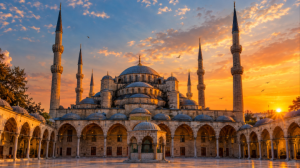
Blue Mosque Istanbul stands as one of the most photographed buildings on earth, yet few visitors know why Sultan Ahmed I risked controversy to build six minarets. Officially named Sultan Ahmed Mosque, it took over 20,000 handmade Iznik tiles, seven years of construction, and one bold architectural gamble to create this masterpiece.
Reviewed for historical accuracy against Ottoman architectural records and UNESCO World Heritage documentation.
Blue Mosque Istanbul: Quick Facts
| Detail | Information |
|---|---|
| Official Name | Sultan Ahmed Mosque (Sultan Ahmet Camii) |
| Location | Sultanahmet, Istanbul, Turkey |
| Built | 1609–1616 |
| Architect | Sedefkar Mehmed Agha |
| Minarets | Six |
| Main Dome Height | 43 meters |
| Capacity | Around 10,000 worshippers |
| Nearest Landmark | Hagia Sophia (directly across the square) |
A Boy Sultan Who Inherited a Fragile Empire
Sultan Ahmed I came to power at just thirteen years old, and he inherited an empire weakened by war. His father, Mehmed III, had died suddenly, leaving the throne to a teenager during one of the most unstable periods of Ottoman history.
The Ottoman treasury had suffered heavy losses after a costly conflict with Persia, and the empire desperately needed a symbol of strength. Meanwhile, uprisings in Anatolia and pressure along the empire’s borders tested the young ruler’s authority almost from the moment he took power.
Ahmed also broke with a grim Ottoman tradition. Previous sultans typically executed their brothers upon taking the throne to eliminate rivals, yet Ahmed spared his brother Mustafa’s life. Historians view this decision as an early sign of the more thoughtful, if occasionally impulsive, character that would later shape his approach to building the mosque.
Why Sultan Ahmed I Wanted to Build a Grand Mosque
Unlike previous sultans, Ahmed had not won a major military victory to fund his mosque through war spoils. Ottoman tradition expected rulers to finance imperial mosques using wealth captured during successful campaigns, and skipping this step broke with decades of precedent.
Therefore, he used the state treasury directly, a decision that many religious scholars of his time criticized. Some viewed it as reckless spending during an already difficult economic period, while others questioned whether a sultan without battlefield glory deserved a mosque of such scale.
He wanted a structure that would rival, and perhaps surpass, the nearby Hagia Sophia, which had stood as a Byzantine cathedral for over a thousand years before its conversion. Building directly across from this ancient landmark was itself a statement of Ottoman confidence and permanence.
How the Blue Mosque Got Its Name
Despite its official title of Sultan Ahmed Mosque, the world knows this building simply as the Blue Mosque Istanbul. The nickname comes entirely from its interior, not its exterior walls, which are actually a soft grey stone.
Inside, more than 20,000 handcrafted ceramic tiles cover the upper walls and domes. Artisans from the city of Iznik created each tile using traditional methods, blending shades of blue, turquoise, and white into intricate floral and geometric patterns. As sunlight filters through the mosque’s 260 stained-glass windows, the tiles glow with a blue hue that gives the building its famous name.
Interestingly, the exterior gives no hint of what waits inside. Visitors often expect blue domes or blue stonework from outside photographs alone, only to discover the true color story once they step through the entrance.
The Controversy of Six Minarets
When construction began, Sultan Ahmed instructed his architect to build six minarets instead of the traditional four. At the time, only one mosque in the entire Islamic world held six minarets, and it happened to be the Masjid al-Haram in Mecca, the holiest site in Islam.
Many scholars viewed this decision as an act of arrogance, believing Sultan Ahmed had placed his own mosque in direct competition with the sacred mosque of Mecca. To resolve the controversy, the sultan reportedly funded the construction of a seventh minaret for Masjid al-Haram, restoring its unique status as the mosque with the most minarets in the Muslim world.
Consequently, the six minarets of Blue Mosque Istanbul remain one of its most striking and debated architectural features to this day. No other Ottoman mosque built after Sultan Ahmed’s reign ever attempted six minarets again, which shows just how sensitive the issue remained for later rulers.
Architectural Design: Domes Built to Overwhelm
Architect Sedefkar Mehmed Agha, a former student of the legendary Ottoman architect Mimar Sinan, designed the mosque using a cascading dome system. A massive central dome rises 43 meters high, supported by four semi-domes and smaller domes surrounding it on every side.
This layered design creates a sense of continuous upward movement, drawing the eye naturally toward the heavens. Thirteen smaller domes complete the visual rhythm, giving the exterior a soft, rolling silhouette rather than a single dominant peak.
The mosque also rests on four massive stone columns, sometimes nicknamed “elephant feet” because of their sheer thickness. These pillars carry the enormous weight of the central dome while remaining largely hidden within the vastness of the prayer hall itself.
The Role of Mimar Sinan’s Legacy in the Design
Although Mimar Sinan died before the Blue Mosque was built, his influence shaped nearly every decision Sedefkar Mehmed Agha made. Sinan had spent decades perfecting dome construction for earlier imperial mosques, and his students carried that knowledge forward into the seventeenth century.
Mehmed Agha studied under Sinan directly and absorbed his teacher’s belief that a mosque’s interior should feel weightless despite its massive stone construction. The semi-domes surrounding the Blue Mosque’s central dome trace directly back to techniques Sinan pioneered decades earlier at other Ottoman mosques across the empire.
In many ways, the Blue Mosque represents the final major expression of Sinan’s architectural philosophy, completed by his most accomplished student after the master’s own death.
The Courtyard and Ablution Fountain
Before entering the prayer hall, visitors pass through a wide courtyard that matches the size of the mosque’s interior. This design choice was intentional, allowing large crowds to gather comfortably during major holidays and Friday prayers.
At the center of the courtyard sits an ornate ablution fountain, once used by worshippers to perform Wudu before prayer. Rows of smaller taps line the outer walls of the courtyard as well, added later to accommodate growing numbers of visitors and worshippers.
A colonnaded walkway surrounds the courtyard on all sides, supported by graceful arches and topped with a series of small domes. This covered space offers shade during Istanbul’s hot summer months and shelter during sudden winter rain.
Inside the Prayer Hall: A Sea of Blue and Light
Stepping inside Blue Mosque Istanbul feels like entering a different world entirely. The vast open floor, uninterrupted by walls, allows thousands of worshippers to pray together beneath a canopy of painted domes and shimmering tile work.
Thick hand-woven carpets cover the entire floor, replaced periodically to preserve their color and comfort. Massive chandeliers hang low over the prayer space, originally designed to hold oil lamps and ostrich eggs, which ancient builders believed repelled spiders and prevented cobwebs from forming near the flames.
A raised platform near the mihrab, known as the sultan’s loge, allowed Ottoman rulers to pray privately while remaining connected to the congregation below. Intricate wooden screens once shielded this royal pavilion from public view, reflecting the careful balance Ottoman architects struck between grandeur and humility before God.
Still a Living Mosque, Not Just a Monument
Unlike many historic buildings that survive only as museums, Blue Mosque Istanbul continues functioning as an active place of worship. Muslims gather here for all five daily prayers, and the mosque fills especially during Friday congregational prayers and throughout Ramadan.
Visitors should note that the mosque closes to tourists briefly during each prayer time, typically for about 90 minutes. Consequently, checking prayer schedules before visiting helps travelers plan their trip without disappointment.
A History of Careful Restoration
Centuries of earthquakes, weather, and heavy foot traffic have gradually worn down parts of the original structure. As a result, the mosque has undergone several major restoration projects since the twentieth century to preserve its tiles, domes, and foundations.
One of the most extensive recent restorations addressed cracks in the domes and deterioration in the historic tilework, a process that required specially trained artisans familiar with traditional Iznik techniques. During major restoration phases, sections of the mosque are sometimes covered in scaffolding, which can affect photographs and limit access to certain areas.
Authorities generally try to keep at least part of the mosque open to worshippers and visitors even during renovation work. However, travelers hoping to photograph the entire structure without obstruction should research the mosque’s current restoration status before finalizing travel plans.
Visiting Blue Mosque Istanbul: What Tourists Should Know
Entry to the mosque remains free of charge, though donations are always welcome and help fund ongoing restoration work. However, visitors must follow a respectful dress code before entering the prayer hall.
Women need to cover their hair, shoulders, and knees, and the mosque provides free headscarves and wraps at the entrance for those unprepared. Men must also wear clothing that covers their shoulders and knees, and everyone must remove their shoes before stepping onto the carpeted floor.
Early morning visits, right after sunrise, offer the smallest crowds and the softest natural light through the stained-glass windows. Afternoon hours near midday often bring the heaviest tourist traffic, especially during peak travel seasons. Parts of the mosque occasionally undergo restoration work, so checking recent visitor reviews before a trip helps confirm the entire structure is open.
Blue Mosque Istanbul and Hagia Sophia: A Historic Rivalry
The Blue Mosque sits directly across Sultanahmet Square from Hagia Sophia, and the two buildings share a fascinating relationship spanning centuries. Sultan Ahmed specifically chose this location to place his new mosque in visual conversation with the ancient structure.
Today, travelers commonly visit both landmarks in a single afternoon, since they stand only a short walk apart. Comparing their domes, minarets, and interior lighting offers a striking lesson in how Ottoman architecture both borrowed from and reimagined earlier Byzantine design.
Nearby Landmarks Worth Visiting
Sultanahmet Square sits at the heart of Istanbul’s historic peninsula, surrounded by several other major attractions within easy walking distance. Topkapi Palace, the former residence of Ottoman sultans, lies just a short walk away and offers insight into the same imperial world that produced the Blue Mosque.
The Hippodrome of Constantinople, once the site of chariot races during the Byzantine era, stretches along the square directly beside the mosque’s courtyard. Ancient obelisks and columns still stand here, connecting visitors to a history that predates the mosque by more than a thousand years.
Many travelers structure a full day around this small district, moving between Hagia Sophia, Topkapi Palace, the Hippodrome, and the Blue Mosque without needing transportation between stops.
Sultan Ahmed’s Tomb: A Final Resting Place Beside His Mosque
Sultan Ahmed I died in 1617, only a year after his mosque’s completion, at the young age of twenty-seven. His illness struck suddenly, and historians believe typhus or a similar fever ended his short reign far earlier than anyone expected.
His tomb stands just outside the mosque complex, along the northern edge of Sultanahmet Square. Several family members, including some of his sons who later became sultans themselves, rest alongside him in the same mausoleum.
Visitors touring the Blue Mosque often stop briefly at this tomb afterward, connecting the young ruler’s short life to the massive, lasting monument he left behind. Few sultans in Ottoman history are remembered so closely through a single building the way Ahmed I is remembered through his mosque.
Common Mistakes Visitors Make
Many tourists arrive without checking prayer times first, only to find the entrance temporarily closed. Planning around the five daily prayers avoids this frustration entirely.
Others forget to bring modest clothing, leading to delays while borrowing coverings at the entrance during busy hours. Additionally, some visitors treat the mosque purely as a photo backdrop, unaware that loud conversations and flash photography during prayer times are considered disrespectful.
Why Blue Mosque Istanbul Still Captivates Millions
Centuries after its completion, this mosque continues drawing visitors from every corner of the globe, and its appeal goes far beyond its striking exterior. The story behind its six minarets, its rivalry with Hagia Sophia, and its living role as an active place of worship all combine into something rare among historic landmarks.
Few buildings manage to remain both a functioning house of worship and a global architectural icon at the same time. Blue Mosque Istanbul achieves both, standing exactly as Sultan Ahmed intended four centuries ago.
Frequently Asked Questions
Why is it called the Blue Mosque?
The nickname comes from the more than 20,000 blue Iznik tiles covering its interior walls and domes, which give the space a soft blue glow.
What is the official name of the Blue Mosque?
Its official name is Sultan Ahmed Mosque, named after the Ottoman sultan who commissioned its construction.
Why does the Blue Mosque have six minarets?
Sultan Ahmed ordered six minarets to rival the grandeur of Masjid al-Haram in Mecca, which was the only mosque with six minarets at the time.
Is the Blue Mosque still used for prayer today?
Yes, it remains an active mosque, and it closes briefly to tourists during each of the five daily prayers.
Is entry to the Blue Mosque free?
Yes, entry is free, though visitors should dress modestly and donations toward restoration are welcomed.
How long did it take to build the Blue Mosque?
Construction took seven years, from 1609 to 1616, under the direction of architect Sedefkar Mehmed Agha.
A Landmark Worth Understanding, Not Just Photographing
Blue Mosque Istanbul offers far more than a beautiful photo opportunity. Its six minarets tell a story of ambition and controversy, its tiles reflect generations of Ottoman craftsmanship, and its continued use as a mosque connects visitors to thirteen centuries of Islamic worship in the same city.
Anyone planning a trip to Istanbul should treat this mosque as a place to slow down, observe respectfully, and appreciate a history that still shapes the skyline today.
Author Description: This article was researched and reviewed against Ottoman architectural records, UNESCO World Heritage documentation on Istanbul’s historic areas, and established historical accounts of Sultan Ahmed I’s reign to ensure factual accuracy.

Comments are closed.
[…] holds several architectural treasures beyond the Blue Mosque. Suleymaniye Mosque, designed by the renowned architect Mimar Sinan, sits atop a hill overlooking […]