





Wudu and Ghusl Valid with a Tattoo? Yes, Here’s Why
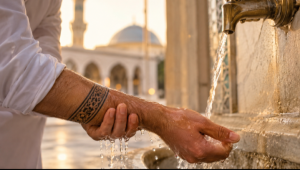
Wudu and Ghusl stay valid with a tattoo. Getting a permanent tattoo is Haram and counts as a major sin, but the ink itself creates no barrier on your skin. Modern tattoo ink sits deep under the skin’s outer layer, so water still reaches the surface fully during purification. This means your Salah stays valid too, even with an old or large tattoo on your body.
Wudu and Ghusl Valid with a Tattoo: The Quick Answer
- Getting a tattoo: Haram for both men and women, based on authentic Hadith.
- Wudu and Ghusl: Stay fully valid, since tattoo ink sits in the dermis, not on the surface.
- Salah: Valid and accepted, because your purification is sound.
- Repentance: Sincere Tawbah wipes out the sin. Removal is only needed if it is safe and affordable.
3 Common Myths About Tattoos and Purification, Busted
Myth 1: A tattoo seals your skin like plastic. False. Tattoo ink sits in the dermis, a layer beneath the skin’s surface. It builds no film on top, so water still touches your skin normally.
Myth 2: A tattoo traps you in permanent impurity. False. Impurity (Janabah) ends the moment you complete Ghusl correctly. Ink under the skin cannot block that process.
Myth 3: Allah rejects prayers from someone with a tattoo. False. Allah accepts Salah performed with valid Wudu and Ghusl. The sin of tattooing and the validity of your prayer are two separate matters.
Wudu and Ghusl Valid with a Tattoo: Why Getting One Is Still Haram
Islamic law treats the human body as a trust (Amanah) from Allah (SWT). You act as a custodian of your body, not its owner, so permanently altering it for fashion or vanity is unlawful.
A tattoo needle punctures the skin repeatedly and pushes ink into the dermis layer. Scholars describe this as an unlawful change to Allah’s creation (Tagheer Khalq Allah), a phrase drawn directly from the wording of the Hadith below.
Authentic Hadith Evidence Against Permanent Tattoos
Ibn Mas’ud reported that the Prophet Muhammad (peace be upon him) said: “Allah has cursed women who tattoo and those who get tattooed, those who pluck facial hair, and those who make gaps between their teeth for beauty, altering the creation of Sahih al-Bukhari, Hadith 4886; Sahih Muslim, Hadith 2125)
A related narration from Ibn Umar adds a second curse specifically on the act of tattooing itself: “The Messenger of Allah cursed the one who tattoos and the one who is tattooed.” (Sahih al-Bukhari, Hadith 5947; Sahih Muslim, Hadith 2124)
Scholars agree this ruling covers both men and women equally. The Hadith names women mainly because pre-Islamic Arab women practiced tattooing more often than men did, often for tribal identity or as a beauty ritual passed down through generations.
Wudu and Ghusl Valid with a Tattoo: The Science Explained
All four schools of Fiqh agree on one core rule: water must touch the outer skin (epidermis) directly. A real barrier, such as nail polish, paint, or wax, blocks this contact and makes Wudu or Ghusl invalid.
How Tattoo Ink Sits Under the Skin
Human skin has two main layers: the epidermis on top and the dermis underneath. A tattoo needle punctures through the epidermis and deposits ink into the dermis, roughly 1 to 2 millimeters deep. Once the wound heals, the epidermis regrows completely and reseals itself over the ink.
Immune cells called macrophages then trap the ink particles in the dermis permanently. This is why tattoos never fade from washing or sweating; the ink sits far below any surface contact.
Why Water Still Reaches Your Skin
- Zero surface obstruction: Tattoo ink builds no membrane on the epidermis.
- Unaltered skin function: The skin still sweats, sheds cells, and absorbs water normally.
- Direct hydration: Water reaches the skin cells directly during Wudu or Ghusl, with nothing in the way.
Barrier vs. No Barrier: A Simple Comparison
| Substance on the skin | Blocks water? | Effect on Wudu/Ghusl |
|---|---|---|
| Permanent tattoo ink (in the dermis) | No | Valid |
| Natural henna stain | No | Valid |
| Nail polish or gel polish | Yes | Invalid until removed |
| Thick waterproof body paint | Yes | Invalid until removed |
| Waterproof sticker tattoo | Yes | Invalid until removed |
| Ordinary lotion or oil | No | Valid |
Since water reaches the outer skin fully, Wudu and Ghusl remain valid even with ink sitting beneath the surface.
What the Four Sunni Madhabs Say
Classical scholars handle old tattoos with real nuance. They balance the seriousness of the sin with the practical need for daily worship.
The Hanafi and Shafi’i schools treat trapped ink as an internal impurity (Najasah Batinah). You cannot wash it away without cutting the skin, so it is legally excused (Ma’fu ‘Anhu). The outer skin stays pure (Tahir), and Wudu and Ghusl work normally.
The Maliki and Hanbali schools focus only on the visible exterior. Water reaches that surface directly, so a past sin does not block a current, valid washing.
All four schools agree on the outcome: your Wudu and Ghusl stay valid with a tattoo, no matter which madhab you follow. Shia jurists reach the same practical conclusion through their own school of Fiqh, ruling that Wudu, Ghusl, and Hajj rites like Tawaf remain sound as long as nothing on the skin physically blocks water.
What Official Fatwa Bodies Have Said
Darul Ifta Deoband, a leading Hanafi fatwa institution, addressed this exact question directly: since a tattoo does not prevent water from reaching the skin, both Wudu and Salah remain valid for the person carrying it (Fatwa: 759/759/B).
You may come across an older, stricter media report from 2012 in which a seminary statement suggested that prayer becomes invalid with a tattoo. That statement reflected a minority, cautionary opinion rather than the mainstream Hanafi position, and later, more detailed fatwas from the same school clarify that Wudu and Salah stay valid once the tattoo already exists on the body. When you compare fatwas, always give more weight to a detailed, reasoned ruling over a short news summary.
Wudu and Ghusl Valid with a Tattoo: Does Size or Location Matter?
Some people worry that a large tattoo, or one on the hands and face, changes the ruling. It does not. Location and size make no difference to Wudu or Ghusl validity, since the only question is whether water reaches the outer skin, and it always does.
A tattoo on the wrists or feet, both washed during Wudu, follows the same ruling as one on the back or leg. The sin itself does not grow with size either; the act of tattooing carries the ruling, not its coverage area.
Will Your Salah Be Accepted with a Tattoo?
Yes, your Salah stays valid and accepted, insha’Allah. Believing otherwise is a harmful and false idea, since skipping prayer is a far greater sin than having a tattoo.
Your Wudu and Ghusl are sound, and that meets the core requirement for valid Salah. When you sincerely repent (Tawbah), Allah forgives the sin fully, and past sins never cancel present obedience.
Henna, Stickers, and Microblading: Does the Ruling Change?
Natural henna (Mehendi): Fully permissible. Plant-based henna stains only dead skin cells and forms no physical layer, so water passes through easily and Wudu and Ghusl stay valid.
Temporary stickers and body paint: These sit on top of the skin with a waterproof adhesive and create a real barrier that blocks water. You must scrub these off before Wudu or Ghusl.
Cosmetic microblading: This punctures the skin like a tattoo and deposits lasting pigment into the eyebrows or lips. Scholars rule it Haram for the same reason as tattoos, though it does not block purification once done.
Health Reasons Scholars Also Discourage Tattoos
Beyond the direct textual prohibition, many scholars point to the physical risks of tattooing as further support for the ruling. The needle repeatedly breaks the skin barrier, which can open the door to infections, allergic reactions to certain inks, and, in rare cases, transmission of bloodborne illness through unsterilized equipment.
Islam places a strong emphasis on avoiding unnecessary harm to the body, so these health risks sit alongside the spiritual reasoning rather than replacing it. This point matters mainly for someone still considering a tattoo, not for someone who already has one.
Wudu and Ghusl Valid with a Tattoo: What to Do If You Already Have One
Step 1: Offer sincere repentance (Tawbah). True repentance needs three things: genuine regret, stopping the act now, and a firm promise never to repeat it. Allah says in the Qur’an: “O you who have believed, repent to Allah with sincere repentance” (Surah At-Tahrim, 66:8).
Step 2: Evaluate safe removal options. Removal is worth trying only if it stays safe, affordable, and tolerable. Laser methods, such as Q-switched or Picosecond lasers, break the ink particles into smaller fragments so your immune system can clear them naturally over several sessions. Darker or older tattoos generally respond faster than bright, saturated colors like green or yellow.
Step 3: Accept the tattoo if removal is unsafe or unaffordable. Islamic law holds that hardship brings ease, and that harm must not cause greater harm. Keep the tattoo, let go of the anxiety, and keep living as a devoted Muslim.
Guidance for Reverts with Tattoos
New Muslims often worry about tattoos from their past life, but Islam offers full reassurance here. The Prophet Muhammad (peace be upon him) said: “Islam wipes out whatever sins came before it” (Sahih Muslim, Hadith 121).
Your record clears fully after the Shahada, so you do not need painful or costly removal just to practice Islam. The same principle explains why a revert’s Salah, Hajj, and other acts of worship are accepted in full from day one.
Frequently Asked Questions
Should I cover my tattoos while praying in the mosque?
Covering them with long sleeves, if you can, keeps decorum in congregation and avoids unwanted comments.
Can a person with a tattoo lead congregational prayer as an Imam?
Yes. If they repented, know the Qur’an and Sunnah well, and perform Wudu correctly, a repented past sin does not disqualify them.
Does a tattoo prevent Hajj or Umrah?
No. A tattoo does not block you from Makkah or Madinah, and you can enter Ihram, perform Tawaf, and complete your pilgrimage normally. For the full purification steps before Ihram, see our Rules of Ghusl: Step-by-Step Purification Guide.
Can I get married if I have a tattoo?
Yes. A tattoo does not affect the validity of Nikah, since it is a personal sin between you and Allah, not a barrier to marriage.
Is tattooing a bigger sin than skipping prayer?
No. Skipping obligatory Salah is a far greater sin than tattooing, even though tattooing remains serious.
What if I only regret my tattoo emotionally, without removing it?
Genuine regret combined with sincere Tawbah is enough, since removal is only recommended when safe and affordable, not a strict requirement for forgiveness.
Does a semi-permanent tattoo that fades over a few years count the same way?
Yes. As long as the ink sits under the skin rather than on top of it, the same ruling applies regardless of how long the tattoo lasts.
Conclusion
Wudu and Ghusl stay valid with a tattoo. The sin lies only in getting the tattoo, never in your purification afterward. If you carry an old tattoo, do not let shame or bad information pull you from Allah. Turn to Him in sincere repentance, focus on your five daily prayers, and trust in His endless mercy.
Did this guide answer your questions about Wudu, Ghusl, and tattoos in Islam? Leave a comment below with your thoughts, share this guide with a revert or friend who needs clear, authentic Islamic knowledge, and subscribe to the Explore Islamic World newsletter for weekly, research-backed guides on Fiqh and daily spiritual growth.
Author: Explore Islamic World Editorial Team — Written, edited, and reviewed by verified Islamic researchers and native English SEO specialists at Explore Islamic World. Our team works with qualified scholars and classical legal sources to deliver factual, authentic Islamic guidance for Western and global English-speaking audiences.

Comments are closed.
[…] law also relies on a key principle: there is no harm and no reciprocating harm. This maxim comes from Hadith literature. A sport built entirely around injuring an opponent […]