




What Is the Quran? Meaning, History, Structure, and Core Themes
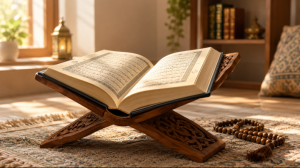
What is the Quran? It is the central book of Islam. Muslims believe it is Allah’s word, revealed to Prophet Muhammad (PBUH) over 23 years. Altogether, it has 114 chapters, called surahs. In addition, it guides worship, belief, and daily life for over a billion Muslims.
Reviewed for accuracy against authentic sources.
Many people, Muslim and non-Muslim, want a clear answer to one simple question. What is the Quran, and why does it matter so much? This guide gives that answer step by step.
First, you will learn its meaning, history, structure, and main themes. Then, you will see how Muslims read it today, and where to start if you are new.
What Is the Quran? The Short Answer
Scan this table first for a fast answer to what is the Quran. After that, read the details in each section below.
| Quick Fact | Detail |
|---|---|
| Meaning of the word | “The Recitation” (from the Arabic root qara’a) |
| Revealed to | Prophet Muhammad (PBUH), through Angel Jibril |
| Period of revelation | About 23 years, from 610 CE to 632 CE |
| Chapters (surahs) | 114 |
| Verses (ayat) | Over 6,000 |
| Language | Arabic |
| Divisions | 30 parts, called juz |
What Does the Word Quran Mean?
The word Quran comes from the Arabic root qara’a. It means “to read” or “to recite.” Notably, this meaning matches the first word the Prophet (PBUH) received in the cave of Hira. There, the angel said, “Read! In the name of your Lord who created” (Qur’an 96:1).
For this reason, Muslims treat the Quran mainly as a recited text, not only a written one. Alongside the written copy, many Muslims keep its words in memory. Indeed, those who memorize all of it are called huffaz.
The Qur’an has other names as well. For example, Muslims call it Al-Furqan (the Criterion), Al-Kitab (the Book), and Adh-Dhikr (the Reminder). Thus, each name highlights one role of the book.
The History of the Quran’s Revelation
Muslims believe that Allah revealed the Quran in stages, from 610 CE until the Prophet’s death in 632 CE. Specifically, the Angel Jibril (Gabriel) delivered each revelation. Next, the Prophet (PBUH) recited it to his companions, who memorized it and wrote it down.
Revelation fell into two broad periods. First, Meccan revelations came before the migration to Madinah. Second, Medinan revelations came after 622 CE.
- Meccan revelations: They focus on core beliefs, such as monotheism, the afterlife, and moral conduct.
- Medinan revelations: They address law, social justice, and the life of an organized community.
As a result, this shift reflects the growing needs of the Muslim community as it became a society.
How the Quran Was Compiled
During the life of the Prophet (PBUH), scribes wrote revelations on parchment, bone, and palm leaves. Many companions also memorized the full text. Then, after his death, the first Caliph, Abu Bakr (RA), ordered the collection of these fragments into one volume. He acted because many memorizers had fallen in battle (Sahih al-Bukhari: 4986).
Later on, the third Caliph, Uthman ibn Affan (RA), sent standardized copies to major cities. This step stopped differences in recitation from spreading (Sahih al-Bukhari: 4987). Today, scholars call this text the Uthmanic codex, and it remains the basis of the Quran that Muslims read today.
The Structure of the Quran
Overall, the Quran contains 114 surahs, or chapters, of varying length. Longer surahs generally appear earlier, while shorter ones appear toward the end. However, this order does not follow the order of revelation.
Each surah divides into verses, called ayat, and the total exceeds 6,000. In addition, the text divides into 30 nearly equal parts called juz.
Because of this, Muslims can read the entire text in one month, especially in Ramadan. Nearly every surah opens with the phrase below.
بِسْمِ اللَّهِ الرَّحْمَٰنِ الرَّحِيمِ
Bismillahir-Rahmanir-Rahim.
“In the name of Allah, the Most Compassionate, the Most Merciful.”
Typically, Muslims say this phrase before they begin a surah, a meal, or any good task.
Meccan and Medinan Surahs
Generally, scholars classify each surah as Meccan or Medinan, based on when and where it was revealed. Meccan surahs tend to be shorter, more poetic, and focused on faith and the hereafter. By contrast, Medinan surahs are usually longer, and they cover detailed legal and social guidance.
The common count lists 86 Meccan and 28 Medinan surahs, though scholars differ on a few of them. Still, this division helps readers understand the context behind verses. A Meccan surah on early persecution reads very differently from a Medinan surah on law.
Famous Surahs and Verses
Certain surahs hold special significance. For instance, Muslims recite Surah Al-Fatiha, the opening chapter, in every unit of the daily prayers. The Prophet (PBUH) said there is no prayer for one who skips it (Sahih al-Bukhari: 756; Sahih Muslim: 394).
Next, Surah Al-Baqarah is the longest chapter, with 286 verses. Notably, it includes Ayat al-Kursi, the Throne Verse, which describes Allah’s power and knowledge. Meanwhile, Surah Al-Ikhlas is one of the shortest, with four verses. The Prophet (PBUH) said it equals one-third of the Quran (Sahih al-Bukhari: 5013).
Core Themes of the Quran
Certain topics recur throughout the text. What is the Quran’s central message? It is Tawhid, the belief that Allah alone deserves worship. The text also tells the stories of earlier prophets, such as Adam, Nuh, Ibrahim, Musa, and Isa.
Beyond belief, the Quran guides worship, family life, business ethics, and justice. For example, it sets rules for prayer, fasting, charity, inheritance, and marriage. Later, Muslim jurists built Islamic law on many of these foundations.
- Belief: One God, angels, scriptures, prophets, the Last Day, and divine decree.
- Worship: Prayer, Zakat, fasting, and pilgrimage, which form the Five Pillars of Islam.
- Character: Honesty, patience, kindness, and justice.
- Stories: Lessons from earlier nations and prophets.
- The Hereafter: Accountability, Paradise, and the Fire.
How Muslims Use the Quran Today
So what is the Quran in daily life? It is a book that Muslims recite, study, and live by. First, they recite portions in each of the five daily prayers. Beyond that, many read a portion each day, and some finish the whole text each month.
Scholars also study the Quran through tafsir, the science of explaining its verses in historical and linguistic context. Consequently, this tradition helps Muslims apply its guidance to modern questions.
The art of recitation, called tajwid, also plays a big role. Specifically, its rules govern the pronunciation, rhythm, and sound of Arabic letters. In many families, children start learning them at a young age.
Meanwhile, digital tools have changed how people read the Quran. For example, apps and websites now offer search, translations, and audio recitations. As a result, both new Muslims and lifelong believers can study verses alongside scholarly commentary.
The Reward of Learning the Quran
The Prophet (PBUH) said the best among you are those who learn the Quran and teach it (Sahih al-Bukhari: 5027). Likewise, he said the Quran will intercede for its companions on the Day of Judgment (Sahih Muslim: 804).
Preservation and Authenticity of the Quran
What is the Quran’s strongest claim about itself? Muslims point to its promise of protection. Thus, they believe it has remained unchanged since its revelation. The Quran states, “Indeed, it is We who sent down the Quran, and indeed, We will be its guardian” (Qur’an 15:9).
History also shows a dual system of memorization and writing. Many companions memorized the Quran during the Prophet’s life. Because of this, any change in the written text would have clashed with the community’s memory.
In fact, researchers have dated early manuscript fragments to within decades of the Prophet’s life. For example, some come from Sana’a in Yemen, and one comes from Birmingham in England. Overall, scholars report that these fragments closely match the Quran Muslims read today.
In addition, authorized recitations (Qira’at) exist, such as Hafs and Warsh. Scholars trace them to the Prophet (PBUH), and they share the same text and meaning.
The Quran’s Literary Style
Because of this, the Quran’s Arabic holds a unique place in the language. Specifically, it blends rhythm, rhyme, and structure in ways that differ from both ordinary prose and classical poetry. For this reason, Muslim scholars describe the style as inimitable.
The Quran itself challenges doubters to produce a surah like it (Qur’an 2:23). Reports say many early listeners, including skilled poets, found its language unlike anything they knew. Even today, Quranic Arabic differs from modern spoken Arabic, so it needs careful study.
How to Start Reading the Quran
Now that you know what is the Quran, begin gently. A little each day is better than a lot once a month.
- Choose a good translation: First, pick one with clear notes from a trusted scholar.
- Start with short surahs: Read Al-Fatiha, Al-Ikhlas, Al-Falaq, and An-Nas first.
- Read with meaning: Next, slow down and reflect on each verse.
- Set a daily time: Also, even five minutes after Fajr builds a strong habit.
- Learn tajwid slowly: Finally, find a teacher, or use a trusted app.
Duas Before and While Reading
Before you recite, seek refuge in Allah from Shaytan (Qur’an 16:98). Therefore, say these words quietly at the start of your reading.
أَعُوذُ بِاللَّهِ مِنَ الشَّيْطَانِ الرَّجِيمِ
A’udhu billahi minash-shaytanir-rajim.
“I seek refuge in Allah from the accursed Shaytan.”
While you study, you may also ask Allah to increase your knowledge. Allah taught the Prophet (PBUH) this short dua (Qur’an 20:114), and you may say it before each study session.
رَبِّ زِدْنِي عِلْمًا
Rabbi zidni ‘ilma.
“My Lord, increase me in knowledge.”
Common Misconceptions About the Quran
Several myths cloud what is the Quran for newcomers. Here are four of the most common.
- Myth: The Quran is only for Arabs. In reality, it addresses all people, and Muslims come from every nation.
- Myth: Reading it needs Arabic fluency. In fact, translations help beginners, and many learn the language over time.
- Myth: It is arranged by date. Instead, surahs mostly run from longer to shorter.
- Myth: The Quran replaces all other sources. In fact, Hadith explain and apply it, as the FAQ below shows.
Frequently Asked Questions (FAQ)
How Long Did It Take to Reveal the Entire Quran?
Answer: Overall, Allah revealed it over about 23 years, from 610 CE until the Prophet’s death in 632 CE.
Is the Quran the Same in Every Country?
Answer: Yes. The Uthmanic text forms the basis of the Quran used worldwide. Authorized recitations, such as Hafs and Warsh, differ only in style, not in meaning.
Can the Quran Be Translated?
Answer: Translations exist in nearly every major language. However, many scholars treat the Arabic text as the true Quran, and they view translations as explanations of its meaning.
What Is the Difference Between the Quran and Hadith?
Answer: The Quran is Allah’s revelation, delivered through Angel Jibril. In contrast, Hadith record the words and actions of the Prophet (PBUH). Therefore, Muslims treat the Quran as the highest authority, and Hadith as the second source that explains it.
How Many Surahs and Verses Does the Quran Have?
Answer: It has 114 surahs and over 6,000 verses, according to the standard count.
Which Surah Should a Beginner Read First?
Answer: Start with Al-Fatiha and the short surahs at the end. Both are easy to memorize, and Muslims recite them in prayer.
Can a Non-Muslim Read the Quran?
Answer: Yes. In fact, anyone may read a translation to learn about Islam. Most scholars ask Muslims to be in a state of purity before touching the Arabic copy. However, they do not apply that condition to a translation.
Final Thoughts
What is the Quran? It is the foundation of Islamic belief and practice. Above all, it shapes how Muslims worship, how they treat others, and how they understand their relationship with God.
From a small cave near Makkah to the hands of over a billion people, the Quran continues to guide. Share this guide with someone who wants to learn about it. And Allah knows best.
References
- The Holy Qur’an: 2:23, 2:185, 15:9, 16:98, 20:114, and 96:1
- Sahih al-Bukhari: 756, 4986, 4987, 5013, and 5027
- Sahih Muslim: 394 and 804
- University of Birmingham: Birmingham Quran manuscript news, 2015
Author Bio
Explore Islamic World Editorial Team
The Explore Islamic World editorial team writes each guide from the Qur’an, Sahih al-Bukhari, Sahih Muslim, and classical tafsir. We check every Hadith number against Sunnah.com before publishing. Where scholars differ, we present each view fairly.

Comments are closed.
[…] Al-Mulk is the 67th chapter of the Qur’an, and it opens Juz 29. Allah (SWT) revealed it in Makkah. Its thirty verses cover His power over the […]
[…] Al-Ikhlas is the 112th chapter of the Qur’an, and it has only four verses. Most scholars say Allah revealed it in Makkah. Its name means […]
[…] The Qur’an treats love between spouses as a sign of Allah’s power, not a side matter. In Surah Ar-Rum, He says: […]