





Tayammum Rules and Rulings: 4 Conditions You Must Know
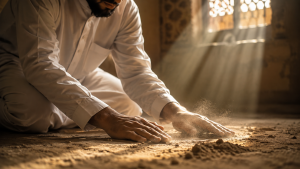
Tayammum rules and rulings allow Muslims to attain ritual purity using clean earth whenever water is unavailable or would harm their health. Allah therefore provided dry ablution as a merciful concession, so physical hardship or water scarcity never stops a believer from praying on time.
| Step | Action Name | Meaning / Purpose |
|---|---|---|
| 1 | Niyyah & Bismillah | Forming the intention to attain purity for worship, for the sake of Allah. |
| 2 | First Strike & Face Wipe | Striking clean earth and wiping the entire face once, completing the first Farz act. |
| 3 | Second Strike & Arm Wipe | Striking clean earth again and wiping both arms up to the elbows once. |
| 4 | Reciting Supplication | Reciting the authentic post-ablution dua to complete the purification process. |
Understanding Tayammum Rules and Rulings in Islamic Jurisprudence
The term Tayammum literally means “aiming for” or “intending” an object in classical Arabic. In Islamic jurisprudence, however, it refers to seeking ritual purity through clean, earth-based materials. Believers therefore use dry ablution as a legal substitute for Wudu or Ghusl under valid circumstances.
Islam, after all, prioritizes ease and accessibility for every worshiper. As a result, Tayammum rules and rulings preserve spiritual discipline while protecting believers from physical harm. When clean water is completely unavailable, similarly, Allah permits dry ablution so spiritual connections remain strong. Consequently, believers can keep their daily prayer schedule without physical hardship or medical risk.
Understanding these rules, therefore, helps Muslims handle travel emergencies, illness, or water shortages. Dry ablution is not merely a symbolic gesture; instead, it fully restores spiritual cleanliness for both obligatory and voluntary worship.
Reviewed for accuracy against authentic sources including Sahih al-Bukhari, Sahih Muslim, and classical jurisprudence references.
Tayammum Rules and Rulings: Is It Obligatory or Sunnah?
Performing dry ablution becomes obligatory (Farz) whenever water is inaccessible or harmful to your health. Attaining ritual purity is, after all, a mandatory prerequisite for valid prayer. Therefore, when the primary means of purification is unavailable, the obligation simply shifts to the legal substitute.
Under normal conditions, performing Wudu or Ghusl with water remains compulsory. However, when valid constraints prevent water use, performing Tayammum instead becomes mandatory. As a result, these rulings ensure that missing prayer due to lack of water is never permissible.
Prayers offered with valid dry ablution are, in fact, fully sound in the sight of Allah. Therefore, you never need to repeat those prayers once water becomes available later. This established principle, ultimately, reflects the core mercy built into Islamic law.
Furthermore, delaying prayer until the window closes while searching for water is incorrect. If water cannot be found after a reasonable effort, therefore, performing dry ablution promptly is required. Thus, believers protect their prayers while following established prophetic guidance.
Qur’anic and Hadith Evidence Behind Tayammum Rules and Rulings
The permissibility of dry ablution, in fact, rests on explicit divine revelation in the Holy Qur’an. Allah Almighty accordingly outlines the foundational principle in Surah Al-Ma’idah:
وَإِن كُنتُم مَّرْضَىٰ أَوْ عَلَىٰ سَفَرٍ أَوْ جَاءَ أَحَدٌ مِّنكُم مِّنَ الْغَائطِ أَوْ لَامَسْتُمُ النِّسَاءَ فَلَمْ تَجِدُوا مَاءً فَتَيَمَّمُوا صَعِيدًا طَيِّبًا فَامْسَحُوا بِوُجُوهِكُمْ وَأَيْدِيكُم مِّنْهُ ۚ مَا يُرِيدُ اللَّهُ لِيَجْعَلَ عَلَيْكُم مِّنْ حَرَجٍ وَلَـٰكِن يُرِيدُ لِيُطَهِّرَكُمْ
“And if you are ill or on a journey or one of you comes from the place of relieving himself or you have contacted women and find no water, then seek clean earth and wipe over your faces and hands with it. Allah does not intend to make difficulty for you, but He intends to purify you.” (Qur’an 5:6)
Additionally, authentic Hadith collections reinforce this foundational blessing. Prophet Muhammad (PBUH), in particular, highlighted this unique privilege in a well-known narration recorded by Imam al-Bukhari:
“I have been given five things which were not given to anyone before me… The earth has been made for me a place of worship and a means of purification. Therefore, my followers can pray wherever the time for prayer overtakes them.” (Sahih al-Bukhari: 335)
This revelation on Tayammum came during an expedition involving Aisha (R.A.), after her necklace was lost in the desert. As a result, the companions had no water for prayer, which caused real concern. Allah then revealed the verse of Tayammum, bringing immediate relief to the Muslim community.
4 Valid Conditions Under Tayammum Rules and Rulings
Muslims cannot perform dry ablution simply for personal convenience. Instead, Islamic jurisprudence outlines specific medical, environmental, and physical circumstances where substituting water becomes valid.
1. Complete Absence or Unavailability of Water
If clean water is unavailable within roughly one mile (1.8 kilometers), dry ablution becomes permissible. However, if you possess a small amount of water needed for drinking or cooking, you must preserve it. Protecting human or animal life, after all, takes legal priority over ritual washing.
That said, basic efforts to locate water are still required beforehand. If you are in an urban area or a campsite, for instance, checking nearby sources first is necessary. If the search turns up nothing, or prayer time is ending, you may then proceed with dry ablution immediately.
2. Severe Illness and Health Risks
If applying water would aggravate an injury, worsen a disease, or delay recovery, dry ablution is permitted. Similarly, if washing causes unbearable pain, using earth replaces water safely. These rulings, therefore, rely on medical guidance from a qualified doctor or on direct personal experience.
For instance, individuals with severe eczema, open surgical wounds, or burn injuries are exempt from using water. Islam, after all, prohibits harming your body to perform worship. Therefore, dry ablution provides a valid, healthy alternative.
3. Extreme Cold Weather and Threat to Life
Severe winter weather or freezing temperatures can make cold water hazardous. If using cold water risks hypothermia or similar harm, likewise, dry ablution becomes valid. However, this exception applies mainly when heating water is genuinely impossible.
If heating equipment or warm water is accessible, using water remains obligatory. Nevertheless, in remote outdoor settings or during power outages in extreme frost, dry ablution safeguards health while preserving prayer times.
4. Security Risks and Safety Hazards
If water exists nearby but reaching it poses danger, dry ablution is fully valid. Threats may include wild animals, hostile environments, or unsafe travel routes. Additionally, if drawing well water is impossible due to missing equipment, dry ablution is permitted.
Likewise, if purchasing water requires an exorbitant price that causes financial distress, using earth is acceptable. These rules, overall, protect believers from physical harm and unjust exploitation alike.
Tayammum Rules and Rulings: The 3 Obligatory Acts (Farz)
To perform dry ablution correctly, you must fulfill three obligatory acts. Missing any single pillar, however, invalidates the entire process. Classical jurists therefore emphasize completing these pillars in strict sequence.
1. Making the Intention (Niyyah)
Intention must reside in your heart before you start the physical actions. You must, specifically, intend to attain ritual purity for worship, for the sake of Allah. Verbalizing the intention is recommended by many scholars, but the heart’s resolve remains the fundamental requirement.
Without a clear intention, touching earth surfaces remains a simple physical movement rather than an act of worship. So focus your mind, first, on purifying yourself before touching the earth.
2. Wiping the Entire Face
The second pillar requires wiping your entire face once with dust-touched hands. The coverage area, specifically, extends vertically from the hairline to the chin. Horizontally, meanwhile, it stretches from earlobe to earlobe.
Make sure the light dust layer touches every visible facial area. However, forcing dust into your eyes or under facial bandages is unnecessary. A smooth, gentle wipe across the surface, ultimately, fulfills the requirement fully.
3. Wiping Both Arms Up to the Elbows
The third pillar requires wiping both arms up to and including the elbows. Wipe the right arm first, then the left. Make sure the entire forearm, wrist, and elbow, in particular, receive coverage.
According to mainstream consensus, interlacing fingers (Khilal) during this step is essential. Interlacing, specifically, ensures dust reaches the spaces between your fingers. Once these three pillars are finished, the obligatory purification is complete.
Tayammum Rules and Rulings: Step-by-Step Guide to Performing It Correctly
Performing dry ablution follows a simple sequence taught by Prophet Muhammad (PBUH). Follow these steps in order, therefore, to ensure proper execution before prayer.
Step 1: Form Intention and Recite Bismillah
Begin by forming a clear intention (Niyyah) in your heart. Then intend to remove ritual impurity so you can pray for Allah. Next, recite the opening supplication out loud:
بِسْمِ اللهِ الرَّحْمٰنِ الرَّحِيمِ
Transliteration: Bismillahir-Rahmanir-Rahim.
Translation: In the name of Allah, the Most Gracious, the Most Merciful.
When Recited: At the very beginning, before touching any earth material.
Step 2: First Touch and Wiping the Face
Spread both hands and strike your palms gently onto clean earth, sand, or stone. If excess dust sticks to your hands, then blow on your palms gently or shake them lightly. This step, overall, keeps the process clean and comfortable.
Next, wipe your entire face once using both palms. Move your hands from your forehead down to your chin, thereby covering the face completely. Remember, the face is wiped only once.
Step 3: Second Touch and Wiping Both Arms
Strike your palms onto the clean earth a second time. Next, place your left palm under your right fingertips. Slide it up the back of your right arm to the elbow. Then bring it back along the inner forearm to the wrist.
Repeat the same motion with your right palm on your left arm, up to the elbow. Finally, interlace your fingers so dust reaches the skin between them.
Step 4: Recite Supplication After Completion
After finishing the physical steps, reciting the post-ablution supplication is a recommended Sunnah. Face the Qiblah, then, and recite:
أَشْهَدُ أَنْ لاَ إِلَهَ إِلاَّ اللَّهُ وَحْدَهُ لاَ شَرِيكَ لَهُ وَأَشْهَدُ أَنَّ مُحَمَّدًا عَبْدُهُ وَرَسُولُهُ
Transliteration: Ash-hadu an la ilaha illallahu wahdahu la sharika lahu, wa ash-hadu anna Muhammadan ‘abduhu wa rasooluh.
Translation: I bear witness that there is no deity worthy of worship except Allah alone, and that Muhammad is His servant and Messenger.
When Recited: Immediately after the arm wipe, while standing in a clean area.
Tayammum Rules and Rulings on Permissible vs. Non-Permissible Materials
Understanding acceptable earth materials is part of following Tayammum rules and rulings correctly. It prevents errors during travel or emergencies. Islamic jurisprudence, accordingly, specifies which natural surfaces qualify for dry ablution.
Permissible Earth Materials
You can perform dry ablution using clean, natural substances that come from the earth. Acceptable options, specifically, include:
- Clean dry soil, clay, or natural ground dust.
- Natural sand, stone, limestone, and granite blocks.
- Unglazed clay pottery, unpainted mud bricks, or raw concrete.
- Marble slabs or tiled surfaces covered with a light layer of natural dust.
Non-Permissible Materials
Materials that do not originate from natural earth surfaces, however, cannot be used. Prohibited options include:
- Metals such as iron, gold, silver, or aluminum.
- Synthetic plastics, vinyl flooring, or painted wood surfaces.
- Combusted materials reduced entirely to wood ash.
- Surfaces contaminated with physical impurities or filth.
What Invalidates Tayammum Rules and Rulings
Under Tayammum rules and rulings, every nullifier that breaks standard Wudu also invalidates dry ablution. Additionally, a few circumstances unique to dry ablution end ritual purity right away.
Standard Nullifiers of Ablution
Events that break standard Wudu, likewise, break dry ablution too. These include bathroom use, passing gas, deep sleep while lying down, or loss of consciousness. If any nullifier occurs, therefore, ritual purity ends immediately.
Consequently, you must repeat dry ablution before your next prayer. Understanding these basic nullifiers, ultimately, helps you maintain correct worship habits.
Availability and Ability to Use Water
Finding usable water, in fact, ends dry ablution immediately. As soon as clean water becomes accessible before you start prayer, dry ablution is voided. You must, instead, perform standard Wudu or Ghusl.
Similarly, if a medical condition improves and water use becomes safe again, dry ablution is no longer valid. Recovering health, after all, removes the legal excuse, so water use becomes compulsory again.
Practical Tips for Following Tayammum Rules and Rulings
To keep your dry ablution valid and stress-free, keep these practical points in mind for daily routines or travel.
Common Mistakes During Tayammum
Many people, in fact, misapply Tayammum rules and rulings simply from a lack of detailed instruction. Avoid, accordingly, these frequent errors:
- Over-soaking hands in dust: excessive dirt on the hands is unnecessary; a light touch is fully sufficient.
- Omitting the elbows: wiping only the wrists or forearms invalidates the third Farz pillar.
- Forgetting finger gaps: failing to interlace fingers leaves skin areas unwiped.
- Using painted or synthetic surfaces: touching plastic or painted walls renders dry ablution void.
Practical Logistics and Travel Tips
When traveling by airplane or train, access to clean earth can feel difficult. However, carrying a small stone or an unglazed clay brick in your bag solves this easily. Storing a clean earth material, therefore, lets you perform dry ablution safely during long journeys.
Additionally, check wall surfaces in hotel rooms or transit stations. Unpainted stone or dust-covered marble tiles, for instance, work as valid surfaces. Planning ahead, therefore, ensures you never miss obligatory prayers while traveling.
Frequently Asked Questions About Tayammum Rules and Rulings
Can I perform multiple prayers with a single Tayammum?
Yes. According to mainstream scholarly consensus, you can offer multiple obligatory and voluntary prayers with one dry ablution. As long as no nullifier occurs and water stays unavailable, your ritual purity remains valid.
Does Tayammum substitute for Ghusl (Full Bath)?
Yes. If major ritual impurity occurs and water is unavailable or dangerous to your health, dry ablution replaces Ghusl. You must, however, form the intention for major purification before starting the steps.
Is performing Tayammum on tiled walls valid?
Yes. Clean ceramic or porcelain tiles made from natural earth minerals are permissible surfaces. That said, making sure the surface is free from synthetic paint or chemical film is recommended.
What if water becomes available while I am praying?
If water becomes available while you are already praying, your prayer remains valid according to most jurists. You may, therefore, finish your prayer without stopping to perform Wudu.
Can a sick person perform Tayammum on a clean pillow or bed?
A bedridden patient can use a pillow or fabric only if it holds a noticeable layer of clean earth dust. If no dust exists on the fabric, however, a stone or clay brick should be provided instead.
Conclusion: Tayammum Rules and Rulings in Summary
Tayammum rules and rulings, ultimately, highlight the deep mercy and flexibility built into Islamic jurisprudence. Allah ensures that physical hardship, illness, or environmental limits never cut believers off from their daily connection to prayer. By following these Quranic and Sunnah guidelines, any Muslim can therefore perform dry ablution correctly whenever water is unavailable.
Author Description / Bio:
Written by the Editorial Team at Explore Islamic World. Our editorial process relies directly on canonical Islamic texts, including Sahih al-Bukhari, Sahih Muslim, and recognized treatises of classical Islamic jurisprudence, cross-checked against Sunnah.com references. We provide verified, E-E-A-T compliant educational content to serve English-speaking Muslim readers globally.

Comments are closed.
[…] perform Tayammum, a person strikes both palms lightly on clean earth, dust, sand, or a stone surface, then wipes the face once, followed by wiping both hands or arms once. Tayammum replaces Wudu entirely for prayer purposes until water becomes available or the underlying excuse ends. Once water is accessible again, a Muslim should return to how to perform Wudu correctly with water rather than continuing with Tayammum. […]
[…] for purification before prayer. It instructs believers who cannot find water after such need to perform Tayammum with clean earth (Surah Al-Ma’idah, […]