





Sunnah vs. Culture: Separating Authentic Worship from Myths on Shab-e-Barat
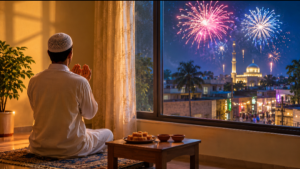
Shab-e-Barat falls on the 15th of Sha’ban, and communities observe it in very different ways. Authentic worship means sincere repentance, dua, Qur’an, and mended relationships. Fixed prayers, fireworks, and invented beliefs come from culture, not the Sunnah. This guide separates the two with evidence.
Reviewed for accuracy against authentic sources.
Picture two homes on Shab-e-Barat. In the first, a family prays quietly, cries a little, and calls a distant cousin. Outside the second, the street erupts with fireworks, and everyone insists the dead have returned.
Both families love Allah (SWT), and both mean well. However, only one of those scenes rests on solid evidence. This article reviews each common practice and shows where it comes from. You also get a clear verdict to explain to your relatives.
Where Shab-e-Barat Comes From
The name is Persian in form. Shab means night, and barat comes from the Arabic bara’ah, meaning release or acquittal. Arab Muslims usually say “the night of mid-Sha’ban” instead.
The authentic texts never use the name Shab-e-Barat. Instead, the narrations speak of the night of the 15th of Sha’ban. Therefore, the name itself is a later cultural label, although a harmless one.
As Shab-e-Barat spread through Persia, India, and Turkey, local customs grew around it. Over centuries, those customs blended with the religious message. Today, many people cannot tell where the Sunnah ends and the tradition begins.
That blending is not a sign of bad intent. It is simply what happens when families pass down habits without checking sources. Your goal is to sort the evidence calmly, not to shame anyone.
The Test Scholars Use to Separate Sunnah From Culture
Scholars apply one simple test to any act of worship. Did the Prophet (PBUH) do it, teach it, or approve it? A yes places it in the Sunnah.
If not, it stays a custom at best. Apply that same test to every Shab-e-Barat custom you inherited. The companions followed the same method, and they were careful to add nothing to worship.
The Prophet (PBUH) said that anything newly added to the religion is rejected. Sahih al-Bukhari 2697 and Sahih Muslim 1718 record this teaching.
Allah (SWT) also says in Surah Al-Ma’idah, verse 3, that He has perfected the religion. Consequently, scholars reason that nobody can add a new act of worship to it. Customs, however, are a different category.
A custom is not automatically wrong. Family meals, gatherings, and favorite dishes are permissible by default. The problem begins only when people attach a religious reward or a fixed ritual to it without evidence.
So use three questions as a filter. Is there an authentic text? Does the act have a fixed form that someone invented?
Do people call it required, or promise special rewards for it? A “no” to the first question and a “yes” to the other two is a warning sign.
Authentic Worship on the 15th of Sha’ban
Every act below suits Shab-e-Barat and has strong support on any night of the year. None depends on a weak narration. As a result, scholars on every side of the debate accept them.
Sincere Repentance
Allah (SWT) loves those who repent, as Surah Al-Baqarah, verse 222, says. Repentance has three parts. Stop the sin, regret it, and resolve not to return.
If you wronged another person, return what you took or ask for pardon. Repentance without that step stays incomplete.
رَبَّنَا ظَلَمْنَا أَنفُسَنَا وَإِن لَّمْ تَغْفِرْ لَنَا وَتَرْحَمْنَا لَنَكُونَنَّ مِنَ الْخَاسِرِينَ
Rabbana zalamna anfusana wa in lam taghfir lana wa tarhamna lanakunanna minal-khasirin.
“Our Lord, we have wronged ourselves. If You do not forgive us and have mercy on us, we will surely be among the losers.”
Exact context of recitation: Adam and Hawwa (AS) said this in Surah Al-A’raf, verse 23. You can recite it after any prayer when you want to ask for forgiveness.
Voluntary Prayer, Quietly and Without a Fixed Form
Night prayer is a well-known Sunnah. Pray the number of rak’ahs you normally pray, and recite what you know. Ibn Taymiyyah (RH) permitted praying alone on Shab-e-Barat, as some early Muslims did.
However, he rejected fixed prayers with set numbers, and he rejected public gatherings for them. The line is simple. Personal worship is welcome, but invented formulas are not.
Mending Broken Ties
The forgiveness narrations mention the person who harbors hatred toward others. Therefore, scholars treat grudges as the biggest barrier to mercy. Sahih al-Bukhari 6077 records that a Muslim may not cut off his brother for more than three nights.
Pick up the phone tonight. A short, sincere message is enough. You do not need a perfect speech.
Fasting, With the Right Understanding
Fasting in Sha’ban has real support. Aisha (RA) said she never saw the Prophet (PBUH) fast more in any month than in Sha’ban. Sahih al-Bukhari 1969 and Sahih Muslim 1156 record this.
Likewise, the Prophet (PBUH) urged fasting three days of each month, as Sahih al-Bukhari 1981 records. The 15th falls among the white days, so fasting it is good for that reason. However, no authentic text names the 15th of Sha’ban itself as a fasting day.
Cultural Practices With No Evidence
Now we turn to the customs attached to Shab-e-Barat. Each one below lacks an authentic text, and each shows how a harmless habit can drift into ritual. The table gives a quick summary before the details.
| Practice | Authentic Evidence? | Scholarly Verdict |
|---|---|---|
| The 100-rak’ah prayer | No, the reports are fabricated | Rejected as an innovation |
| Fireworks and loud celebrations | No | Wasteful, and disliked or forbidden |
| Cooking sweets as a religious rite | No | Food is permissible, but the ritual meaning is not |
| “Souls of the dead return tonight” | No | Baseless belief |
| “Your fate is written tonight” | No, the verse points to Laylatul Qadr | Misreading of the Qur’an |
| Visiting graves on this night only | No fixed night is prescribed | Visiting is Sunnah, but singling out the night is not |
The 100-Rak’ah Prayer
Some communities teach a prayer of 100 rak’ahs, with a set number of Surah Ikhlas in each. Hadith scholars classify the reports behind it as fabricated. No companion practiced it, and no early scholar taught it.
Pushing a heavy prayer on people also contradicts the Prophet’s ease. Therefore, if someone hands you a fixed formula for the night, ask for the chain of narration.
Fireworks, Loud Gatherings, and Spending
Fireworks have no link to the Sunnah at all. They disturb neighbors, frighten children and animals, and burn money. Allah (SWT) warns in Surah Al-Isra, verses 26 and 27, that wasteful people are brothers of the devils.
Noise also defeats the purpose of Shab-e-Barat. Repentance needs a quiet heart. Spend that money on a family in need instead.
Sweets and Special Meals
Many families cook halwa or other sweets. Cooking and sharing food is permissible, and sharing with neighbors is even rewarded. The trouble begins when people treat the sweet as part of the worship.
A popular legend ties halwa to the broken tooth of the Prophet (PBUH) at Uhud. No authentic report supports that story. So enjoy the food as a family treat, and never call it a required rite.
The Belief That Souls Return Home
Some households light lamps because they believe the dead return that night. No sound narration says so. Such beliefs about the unseen need clear evidence, and none exists here.
Ignoring this myth does not make you cold toward your parents. The best gift for the deceased is dua and charity, which the Sunnah actually teaches.
“Your Fate Is Written Tonight”
Many people quote Surah Ad-Dukhan, verses 3 and 4, to claim this. Those verses describe a blessed night when matters of wisdom are made distinct. Most early commentators linked that night to Laylatul Qadr in Ramadan.
Surah Al-Qadr, verse 1, supports that view, because it places the Qur’an’s revelation on the Night of Decree. A few scholars applied the verses to mid-Sha’ban, but Ibn Kathir (RH) rejected that reading. Therefore, do not tell anyone their year is sealed tonight.
Visiting Graves on This Night
Visiting graves is a real Sunnah. The Prophet (PBUH) told people to visit them because they remind us of the hereafter, as Sahih Muslim 977 records. However, no authentic text fixes the 15th of Sha’ban for it.
The famous story of Aisha (RA) following the Prophet (PBUH) to Baqi on this night appears in Jami at-Tirmidhi 739. Scholars grade it weak, because the chain has a break. Sahih Muslim 974 does show him visiting Baqi at night, but that report names no date.
So visit the graves when your heart is soft, on any day of the week. Make the visit simple and quiet.
السَّلَامُ عَلَيْكُمْ أَهْلَ الدِّيَارِ مِنَ الْمُؤْمِنِينَ وَالْمُسْلِمِينَ، وَإِنَّا إِنْ شَاءَ اللَّهُ بِكُمْ لَاحِقُونَ، أَسْأَلُ اللَّهَ لَنَا وَلَكُمُ الْعَافِيَةَ
As-salamu alaykum ahlad-diyari minal-mu’minina wal-muslimin, wa inna in sha Allahu bikum lahiqun, as’alullaha lana wa lakumul-afiyah.
“Peace be upon you, people of these abodes, among the believers and Muslims. If Allah wills, we will join you. I ask Allah for safety for us and for you.”
Exact context of recitation: The Prophet (PBUH) taught this greeting for visiting graves. Sahih Muslim 975 records it.
Why Myths Spread So Easily
Myths about Shab-e-Barat travel fast because they come wrapped in love. A grandmother passes down a story with tears in her eyes, so nobody questions it. Social media then multiplies the effect in seconds.
Forwarded messages make it worse. A single image with a fake hadith can reach thousands before anyone checks it. As a result, people confuse repetition with proof.
Another reason is the pull of group identity. Practices feel like belonging. Dropping a custom can feel like leaving the family, even when the custom has no source.
Therefore, the cure is not harshness. The cure is a calm habit of asking, “Where is this from?” before you believe or forward anything.
Consider a simple routine. Before sharing any message about the night, check whether it names a collection and a hadith number. Then search that number yourself. If you cannot find the text, do not send it on.
Students of knowledge can help too. A short question to a trusted local scholar often settles a family debate. As a result, the whole household learns the answer together.
How to Talk to Family Without Starting a Fight
Your relatives may hold their Shab-e-Barat customs with deep sincerity. Correcting them harshly will only harden their position. Gentleness works far better, and it is also the Sunnah.
Try these steps in order:
- Start with agreement. Praise their love for worship and their wish to be forgiven.
- Offer the alternative. Say, “Let’s all make dua together instead,” rather than “That’s wrong.”
- Share a source. Show one reference, and let them read it themselves.
- Keep food and gatherings. Eating together is permissible, so drop only the ritual meaning.
- Know when to stop. One kind conversation is enough, and guidance belongs to Allah (SWT).
Elders especially deserve patience. Often they need to hear that they are not being accused of bad intentions. After that, they listen far more openly.
A Simple Plan for the 15th of Sha’ban
Here is a calm Shab-e-Barat plan that uses only well-supported acts. It takes about 45 minutes, and it is a suggestion, not a ritual.
- 10 minutes: Istighfar after Maghrib or Isha.
- 15 minutes: Recite the Qur’an with its meaning.
- 10 minutes: Pray your usual voluntary rak’ahs, then make dua in your own words.
- 5 minutes: Send one message to mend a broken tie.
- Next day: Fast if you are able, since it falls among the white days.
Sayyidul Istighfar fits Shab-e-Barat perfectly. The Prophet (PBUH) called it the master of seeking forgiveness, and Sahih al-Bukhari 6306 records its virtue.
اللَّهُمَّ أَنْتَ رَبِّي لَا إِلَهَ إِلَّا أَنْتَ، خَلَقْتَنِي وَأَنَا عَبْدُكَ، وَأَنَا عَلَى عَهْدِكَ وَوَعْدِكَ مَا اسْتَطَعْتُ، أَعُوذُ بِكَ مِنْ شَرِّ مَا صَنَعْتُ، أَبُوءُ لَكَ بِنِعْمَتِكَ عَلَيَّ، وَأَبُوءُ بِذَنْبِي فَاغْفِرْ لِي، فَإِنَّهُ لَا يَغْفِرُ الذُّنُوبَ إِلَّا أَنْتَ
Allahumma anta rabbi la ilaha illa anta, khalaqtani wa ana abduka. Wa ana ala ahdika wa wa’dika mastata’t, a’udhu bika min sharri ma sana’t. Abu’u laka bi ni’matika alayya, wa abu’u bi dhanbi faghfir li. Fa innahu la yaghfirudh-dhunuba illa anta.
“O Allah, You are my Lord. None has the right to be worshipped but You. You created me, and I am Your servant. As best I can, I keep Your covenant and promise.
From the evil I have done, I seek refuge in You. Your favor upon me I acknowledge, and I acknowledge my sin, so forgive me. Truly, none forgives sins except You.”
Exact context of recitation: Recite it each morning and evening, with firm faith in its meaning.
Frequently Asked Questions
Is it haram to cook sweets on the 15th of Sha’ban?
No, cooking and sharing food is permissible. The problem arises only when people treat the sweet as a required act of worship. Enjoy it as a family meal and nothing more.
Can I pray at home on this night?
Yes, voluntary prayer is always welcome. Pray the usual number of rak’ahs, without a fixed formula. Scholars differ on singling out Shab-e-Barat, but all accept personal worship.
Is it wrong to visit graves on this night?
Visiting graves is a Sunnah on any day. However, no authentic text assigns it to this night. Visit when you feel the need, and recite the Prophetic greeting.
Do I have to fast on the 15th of Sha’ban?
No, nobody must fast on it. Fasting is recommended, since the 15th falls among the white days. Jami at-Tirmidhi 761 records the Prophet’s encouragement to fast them.
How can I correct my family without hurting them?
Lead with respect, offer a better alternative, and share one source. Then leave the matter with Allah (SWT). Gentle words open far more hearts than sharp ones.
Keep What Is Authentic, Let Go of the Rest
The night of the 15th of Sha’ban can still be beautiful. Repentance, dua, Qur’an, and reconciliation need no invented additions. They are enough, and they are exactly what the Prophet (PBUH) loved.
So sort your family’s Shab-e-Barat habits with the three-question filter. Keep the good, drop the invented, and stay kind throughout. Then enter Ramadan with a clean heart and a clear plan.
Share this guide with one relative who keeps asking about Shab-e-Barat. Then make a sincere dua for the whole Ummah, including the person who sent it to you.
Author Description/Bio:
The Explore Islamic World editorial team writes every article from the Qur’an and authentic hadith, with references checked against Sahih al-Bukhari, Sahih Muslim, and Sunnah.com. Each piece is reviewed for accuracy before publication and reflects mainstream scholarly positions. Where scholars differ, we present each view fairly.
