





Acrylic Nails and Wudu: The Truth About Fake Lashes and Salah for Muslim Women
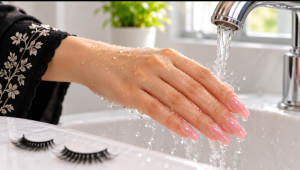
Acrylic nails and wudu do not mix, because acrylic forms a waterproof layer that stops water touching the nail. Remove nail polish and acrylics before wudu and ghusl. Eyelash extensions are debated among scholars, so removable strip lashes are the safer choice.
Reviewed for accuracy against authentic sources.
| Step | Name | Meaning/Purpose |
|---|---|---|
| 1 | Check | Spot any acrylic, gel, polish, glue or sealant on the nails and lash line. |
| 2 | Remove | Take off every waterproof layer so nothing blocks the water. |
| 3 | Wash | Perform wudu so water reaches the face, hands and feet fully. |
| 4 | Verify | Look at each nail once more to confirm water touched bare skin. |
| 5 | Pray | Offer salah, because valid wudu is the key to a valid prayer. |
You book the salon appointment, and the nails look stunning. Then Asr time arrives, and a quiet question appears. Will your wudu still count?
Many Muslim women face the acrylic nails and wudu dilemma every week. Weddings, work culture and social media all push toward polished hands and long lashes. However, Islam asks for something very specific before prayer: clean skin that water actually touches.
This guide explains acrylic nails and wudu, along with lashes, polish, henna and ghusl. You will find clear rulings, Qur’an and Hadith references, and practical fixes. Therefore, you can enjoy beauty without putting your salah at risk.
Why Wudu Demands Water on Bare Skin
Allah (SWT) commands believers to wash their faces and their hands up to the elbows. He also tells them to wipe their heads and wash their feet to the ankles (Surah Al-Ma’idah 5:6). The command names body parts, not just a ritual motion.
Mainstream scholars read this verse the same way. Water must reach the skin itself. As a result, anything that seals the skin from water counts as a barrier.
The Hadith shows how seriously this matters. Abdullah ibn Amr (RA) reported that Prophet Muhammad (PBUH) saw companions rushing through wudu and leaving their heels dry. The Prophet (PBUH) warned that those heels would face the Fire (Sahih al-Bukhari, Hadith 60; Sahih Muslim, Hadith 241).
Another report speaks directly to nails. Umar ibn al-Khattab (RA) said a man left a spot the size of a fingernail dry on his foot. The Prophet (PBUH) told him to go back and perform wudu properly (Sahih Muslim, Hadith 243).
Consider that standard for a moment. A patch the size of one fingernail needed correction. Therefore, acrylic nails and wudu fail the same test, since a full layer covers every nail.
Why Acrylic Nails and Wudu Cannot Go Together
Acrylic nails start as a liquid and powder that harden into a plastic shell. That shell sits on top of your natural nail. Water rolls off it and never reaches the nail underneath.
Because the hands must be washed fully, scholars rule that a waterproof coating invalidates wudu. This applies equally to acrylic, gel extensions, dip powder and glued-on tips. In other words, the technique does not matter, but the barrier does.
Some women hope that wiping over the nails could replace washing. However, wiping (mas’h) is allowed only in specific cases, such as leather socks or a medical bandage. Cosmetic coverings do not qualify.
What if the acrylic nails and wudu question involves tips extending only past the fingertip? Even then, the coating usually covers the nail plate itself. Hence, scholars still advise removal before every wudu.
Acrylic nails and wudu clash on hygiene grounds too. Moisture and dirt can collect beneath a lifted edge. For that reason, many women find that removal helps their nails as well as their prayer.
Nail Polish, Gel and Henna: What Passes and What Fails
Regular nail polish forms a film over the nail. Therefore, wudu with polish on does not count. Gel polish and shellac behave the same way, only more stubbornly.
Henna works differently. It stains the nail and skin without leaving a layer. As a result, scholars agree that henna does not block water, and wudu stays valid.
Many women want a practical rhythm. Polish suits the days of menstruation, since prayer is not required then. Still, you must remove it before the final ghusl, so plan that last day carefully.
Salon culture rarely accounts for prayer. Technicians seldom know the rules on acrylic nails and wudu, so you must lead the conversation. Ask about removal time and non-acetone options before you book.
Is Breathable Polish Really Valid?
Some brands advertise “water-permeable” or “halal” polish. They claim that water passes through the film to the nail underneath.
Scholars remain divided on these products. Some contemporary scholars accept them when independent lab tests confirm real permeability. Others advise caution, because a film is still a film.
Therefore, treat marketing claims carefully. Ask for lab evidence, not slogans. If doubt remains, remove the polish and wash the nails directly.
What About Natural Long Nails?
Natural long nails are fine for wudu. However, dirt packed beneath the nail can stop water from reaching the skin. So, clear any visible debris before you wash.
The Prophet (PBUH) also listed clipping nails among the acts of fitrah (Sahih Muslim, Hadith 261). As a result, short and clean nails support both hygiene and a worry-free wudu.
Fake Eyelashes in Islam: Where Scholars Differ
Fake lashes raise a different question from nails. The issue is less about wudu and more about whether adding to your natural look is permitted. Scholars have discussed this for years, and their views do vary.
Two reports shape the debate. Asma bint Abi Bakr (RA) described a woman whose daughter lost her hair to illness. The Prophet (PBUH) said Allah curses women who attach hair or request it (Sahih Muslim, Hadith 2122).
Ibn Umar (RA) reported a similar warning. The Prophet (PBUH) cursed the woman who attaches hair and the woman who gets tattooed (Sahih al-Bukhari, Hadith 5937).
Scholars who prohibit lash extensions reason by analogy. Glued lashes add artificial hair, similar to hair extensions. They also warn that attached lashes can mislead people about your natural appearance.
Other scholars distinguish lashes from scalp hair. They note that the reports name hair and tattooing specifically. Therefore, some contemporary scholars allow removable lashes for adornment when no harm or deception is involved.
Because opinions differ, follow a trusted scholar from your own school of thought. Additionally, avoiding the doubtful option protects both your faith and your peace of mind.
Strip Lashes vs Glued Extensions
Strip lashes sit on the lid for a few hours and peel off easily. Because they are removable, many scholars treat them more leniently. Semi-permanent extensions, on the other hand, are bonded to each natural lash.
Extensions also create practical problems for worship. Oils and sealants can sit on the eyelid skin, and glue can trap debris. In addition, women often avoid washing properly because they fear loosening the bond.
The cautious path is therefore simple. Choose strip lashes for special events, and remove them when the glue strip touches skin you must wash. Think twice before permanent bonding if you pray five times daily.
Do Lash Extensions Break Your Wudu?
Extensions do not break wudu the way sleep or passing wind does. The real question is whether they block water from skin you must wash. Natural lashes are hair on the face, so water passing over them is enough.
However, glue or sealant on the eyelid skin forms a barrier. In that case, remove it and wash again. Likewise, you are not required to wash the inside of the eye.
Ghusl and Fake Nails After Your Period
Ghusl is the full-body purification after menstruation, postnatal bleeding or intimacy. Water must reach every part of the skin, including the nails. Therefore, the logic behind acrylic nails and wudu applies to ghusl too.
Umm Salamah (RA) once asked the Prophet (PBUH) whether she must undo her braids for ghusl. He said pouring water over her head three times was enough (Sahih Muslim, Hadith 330). That ease concerns braids that water can pass through, not waterproof layers over skin.
Timing matters here. Polish comes off in minutes, while acrylics need a technician. Therefore, book that removal well before your period ends.
What If You Already Prayed With Nail Coverings On?
Many women ask this with real worry. Start with the principle. The Prophet (PBUH) said Allah rejects the prayer of anyone without wudu until they renew it (Sahih al-Bukhari, Hadith 135).
If you mixed acrylic nails and wudu in the past, scholars generally ask you to repeat those prayers. However, some treat sincere ignorance more leniently. Allah (SWT) also reminds us that He does not burden a soul beyond its capacity (Surah Al-Baqarah 2:286).
Therefore, speak to a qualified scholar about prayers you already offered. Do not spiral into guilt. Instead, correct the habit from today and ask Allah (SWT) for forgiveness.
Medical Nails, Bandages and Genuine Hardship
Some women wear a medical covering prescribed by a doctor, for example after a nail injury. Scholars treat medical coverings differently from decoration. In many rulings, wiping over the covering with wet hands replaces washing that spot.
Genuine hardship is the key test. Cosmetic preference never qualifies, but medical need can. Because details vary by case, ask a qualified scholar about your situation.
Common Beauty Situations and the Right Move
Weddings and Eid Events
Special events create the biggest pressure to keep nails and lashes on all day. Plan ahead instead. Henna on your hands stays beautiful and never blocks water.
If you want colour, apply polish after Isha and remove it before Fajr. Alternatively, wear removable press-ons only when you can take them off for each wudu. Then you will never choose between the party and the prayer.
Work and Professional Settings
Professional settings often expect neat nails. A short, buffed manicure looks polished without any barrier. Meanwhile, your wudu stays simple and stress-free.
Travel and Long Days
Long travel days make salon removal impossible. Therefore, avoid new acrylics right before a trip. Pack a gentle remover for polish and a small brush for cleaning under the nails.
Three Myths About Nails, Lashes and Salah
Many women believe a little polish is fine if most of the nail is bare. In reality, any coating blocks water in that spot. The Hadith of the dry fingernail patch settles this point.
Another claim says wiping over cosmetic coverings is allowed. Scholars reserve wiping for leather socks and medical bandages. As a result, salon products never qualify.
A third claim says lash extensions break wudu the way acrylic does. They do not. However, anything on the skin that blocks water must go, so check the lash line carefully.
A Simple Routine for Muslim Women Who Love Beauty
Beauty is not forbidden in Islam. The Prophet (PBUH) said Allah is beautiful and loves beauty (Sahih Muslim, Hadith 91). A sound routine keeps acrylic nails and wudu apart while protecting your style.
- Choose henna, a natural manicure or removable press-ons for your hands.
- Avoid glued extensions if you pray five times daily.
- Remove polish or press-ons before every wudu, not just the first one of the day.
- Check each nail and your eyelid skin for leftover glue before you wash.
- Carry a small remover pad when you travel or work long hours.
- Ask a qualified scholar whenever your situation feels unusual.
After finishing wudu, say the short testimony that opens the doors of Paradise. Uqbah ibn Amir (RA) reported that Prophet Muhammad (PBUH) promised Paradise’s eight gates to reciters (Sahih Muslim, Hadith 234).
Arabic: أَشْهَدُ أَنْ لَا إِلَهَ إِلَّا اللَّهُ وَحْدَهُ لَا شَرِيكَ لَهُ، وَأَشْهَدُ أَنَّ مُحَمَّدًا عَبْدُهُ وَرَسُولُهُ
Transliteration: Ash-hadu an la ilaha illallahu wahdahu la sharika lahu, wa ash-hadu anna Muhammadan abduhu wa rasuluhu.
Meaning: “I bear witness that there is no god but Allah alone, with no partner. I also bear witness that Muhammad is His servant and Messenger.”
Context of Recitation: Recite it right after completing wudu, before you leave the place of washing.
Halal Alternatives That Protect Your Look and Your Prayer
Henna is the classic choice. It decorates the hands, lasts for days and never forms a waterproof layer. Many women also find that its warm colour suits Eid outfits beautifully.
A clean natural manicure works too. Buff the nail, shape it and keep the length modest. Thus, the conflict between acrylic nails and wudu disappears from your daily routine.
For lashes, choose strip lashes for events only. Treat them as occasional adornment, not a daily habit. Meanwhile, your natural lashes stay healthy and your wudu stays simple.
Frequently Asked Questions
Can I pray with acrylic nails on?
No, you should remove them first. Acrylic blocks water from reaching the nail, so wudu stays incomplete. Prayer without valid wudu does not count.
Is nail polish haram in Islam?
Polish itself is not haram. The problem is the barrier it creates for wudu and ghusl. Therefore, wear it only when you are exempt from prayer, or remove it before each wudu.
Does henna affect wudu?
No, henna does not affect wudu. It stains the skin and leaves no waterproof layer. However, wash off the dried paste first, since only the stain should remain.
Are eyelash extensions haram?
Scholars differ on this question. Some prohibit glued extensions by analogy with attaching hair, while others allow removable lashes. Follow a trusted scholar and avoid doubtful options.
Can I wipe over my nails instead of washing them?
Not for cosmetic coverings. Wiping applies to leather socks and medical bandages. Therefore, remove polish and acrylics, then wash the nails directly.
The Bottom Line for Your Next Salon Visit
The rule is short. Water must touch your nails and the skin you wash, and nothing waterproof may sit in between. That single idea answers most questions about acrylic nails and wudu, polish and gel.
Lashes call for more care because scholars differ. Strip lashes and honest caution protect both your adornment and your conscience. Ask a trusted scholar whenever doubt remains.
Beauty and worship can live together. Choose henna, natural nails and removable lashes, then wash with confidence. May Allah (SWT) accept your wudu and your salah.
About the Author: The Explore Islamic World editorial team checks every ruling against Sahih al-Bukhari, Sahih Muslim and Sunnah.com. It also verifies Qur’anic verses against the Mushaf. Each article follows mainstream scholarly consensus and states differences of opinion honestly. This guide offers general education, so please consult a qualified local scholar for personal cases.

Comments are closed.
[…] of fiqh agree on one core rule. Water must touch the outer skin directly. A real barrier, such as nail polish, paint, or wax, blocks that contact and makes wudu or ghusl […]